Minimum Dominating Set Problem
A dominating set of an undirected graph $G=(V,E)$ is a subset $S\subseteq V$ such that every node $u\in V$ is either in $S$ or adjacent to a vertex in $S$.
Let $N(u)={v\in V\mid (u,v)\in E}$ be the set of neighbors of $u\in V$, and let $N[u]={u}\cup N(u)$ be the closed neighborhood of $u$. Then $S$ is a dominating set if and only if
\[\begin{aligned} V = \bigcup_{u\in V} N[u]. \end{aligned}\]The minimum dominating set problem aims to find the dominating set with the minimum cardinality. On an $n$-node graph $G=(V,E)$ with nodes labeled $0,1,\ldots,n−1$, we introduce $n$ binary variables $x_0, x_1, \ldots, x_{n-1}$ where $x_i=1$ if and only if node $i$ is included in the dominating set $S$. Using negated literals $\overline{x}_i$ (where $\overline{x}_i=1$ iff $x_i=0$) simplifies the HUBO constraint formulation, as shown below.
We will show two formulations:
- HUBO formulation: the expression may include higher-degree terms.
- QUBO formulation: the expression is quadratic, but auxiliary variables are used.
HUBO formulation of the minimum dominating set problem
For each node $i\in V$, the following condition must be satisfied:
- $x_j=1$ for some $j\in N[i]$ (i.e., node $i$ is dominated).
Node $i$ is NOT dominated only when $x_j=0$ for all $j\in N[i]$, i.e., $\prod_{j\in N[i]}\overline{x}_j=1$. Thus, we define the constraint as:
\[\begin{aligned} \text{constraint} = \sum_{i=0}^{n-1} \prod_{j\in N[i]}\overline{x}_j \end{aligned}\]The degree of the term for node $i$ is $\lvert N[i] \rvert$, so the constraint may not be quadratic.
The objective is to minimize the number of selected nodes:
\[\begin{aligned} \text{objective} = \sum_{i=0}^{n-1} x_i \end{aligned}\]Finally, the expression $f$ as:
\[\begin{aligned} f &= \text{objective} + (n+1)\times \text{constraint} \end{aligned}\]The penalty coefficient $n+1$ is a safe choice to prioritize satisfying the dominating-set constraints over minimizing the objective.
QUBO++ program for the HUBO formulation
The following QUBO++ program finds a solution for a graph with $N=16$ nodes:
#include <qbpp/qbpp.hpp>
#include <qbpp/easy_solver.hpp>
#include <qbpp/graph.hpp>

int main() {
  const size_t N = 16;
  std::vector<std::pair<size_t, size_t>> edges = {
      {0, 1},   {0, 2},   {1, 3},   {1, 4},   {2, 5},  {2, 6},
      {3, 7},   {3, 13},  {4, 6},   {4, 7},   {5, 8},  {6, 8},
      {6, 14},  {7, 14},  {8, 9},   {9, 10},  {9, 12}, {10, 11},
      {10, 12}, {11, 13}, {12, 14}, {13, 15}, {14, 15}};

  std::vector<std::vector<size_t>> adj(N);
  for (const auto& e : edges) {
    adj[e.first].push_back(e.second);
    adj[e.second].push_back(e.first);
  }

  auto x = qbpp::var("x", N);

  auto objective = qbpp::sum(x);

  auto constraint = qbpp::toExpr(0);
  for (size_t i = 0; i < N; ++i) {
    auto t = qbpp::toExpr(~x[i]);
    for (size_t j : adj[i]) {
      t *= ~x[j];
    }
    constraint += t;
  }

  auto f = objective + (N + 1) * constraint;
  f.simplify_as_binary();

  auto solver = qbpp::easy_solver::EasySolver(f);
  auto sol = solver.search({{"time_limit", 1.0}});

  std::cout << "objective = " << objective(sol) << std::endl;
  std::cout << "constraint = " << constraint(sol) << std::endl;

  qbpp::graph::GraphDrawer graph;
  for (size_t i = 0; i < N; ++i) {
    graph.add_node(qbpp::graph::Node(i).color(sol(x[i])));
  }
  for (const auto& e : edges) {
    graph.add_edge(qbpp::graph::Edge(e.first, e.second));
  }
  graph.write("dominatingset.svg");
}
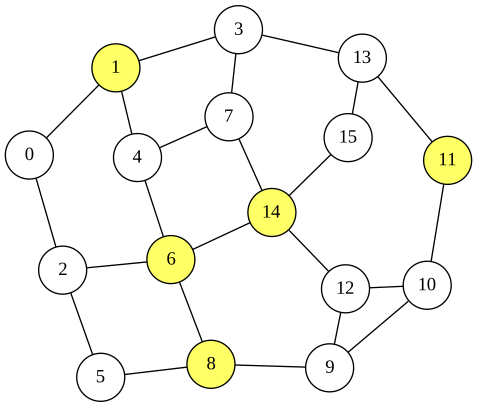
This program first builds the adjacency list adj from the edge list edges, where each adj[i] stores the neighbors of vertex i. It then constructs constraint, objective, and f according to the HUBO formulation. The Easy Solver is applied to f to obtain a solution sol. The values of objective and constraint for sol are printed, and the resulting graph is saved as dominatingset.svg, where the selected vertices are highlighted.
This program produces the following output:
objective = 5
constraint = 0
The image file stores the following image:
QUBO formulation and the QUBO++ program
A node $i$ is dominated if $N[i]\cap S$ is not empty. Using binary variables $x_i$ (where $x_j=1$ means node $j$ is in $S$), this condition is equivalent to the following inequality:
\[\begin{aligned} \sum_{j\in N[i]}x_j &\geq 1 \end{aligned}\]In QUBO++ notation, we can express the dominating-set constraints by summing the penalty expressions:
\[\begin{aligned} \text{constraint} &= \sum_{i=0}^{n-1} \bigl(\sum_{j\in N[i]}x_j \geq 1\bigr) \end{aligned}\]The objective and f can be defined in the same way as the HUBO formulation.
The constraint above can be described as a QUBO++ program as follows:
  auto constraint = qbpp::toExpr(0);
  for (size_t i = 0; i < N; ++i) {
    auto t = qbpp::toExpr(x[i]);
    for (size_t j : adj[i]) {
      t += x[j];
    }
    constraint += 1 <= t <= +qbpp::inf;
  }
In this code, t stores the expression
and the range operator creates a penalty expression for
\[1\leq \sum_{j\in N[i]}x_j \leq +\infty,\]which takes the minimum value 0 if and only if the inequality is satisfied. By minimizing f, the program finds a minimum dominating set.
最小支配集合問題
無向グラフ $G=(V,E)$ の支配集合とは、すべての頂点 $u\in V$ が $S$ に含まれるか、$S$ 中の頂点に隣接しているような部分集合 $S\subseteq V$ のことです。
$N(u)={v\in V\mid (u,v)\in E}$ を $u\in V$ の隣接頂点の集合、$N[u]={u}\cup N(u)$ を $u$ の閉近傍とします。 このとき、$S$ が支配集合であるための必要十分条件は
\[\begin{aligned} V = \bigcup_{u\in V} N[u]. \end{aligned}\]です。
最小支配集合問題は、要素数が最小の支配集合を求める問題です。 $n$ 頂点のグラフ $G=(V,E)$(頂点に $0,1,\ldots,n-1$ のラベルが付いている)に対して、$n$ 個のバイナリ変数 $x_0, x_1, \ldots, x_{n-1}$ を導入します。ここで $x_i=1$ は頂点 $i$ が支配集合 $S$ に含まれる場合です。 否定リテラル $\overline{x}_i$($\overline{x}_i=1$ は $x_i=0$ のとき)を用いると、以下に示すようにHUBO制約の定式化が簡潔になります。
2つの定式化を示します:
- HUBO定式化: 式に高次の項が含まれる場合があります。
- QUBO定式化: 式は2次ですが、補助変数を使用します。
最小支配集合問題のHUBO定式化
各頂点 $i\in V$ に対して、以下の条件が満たされなければなりません:
- ある $j\in N[i]$ に対して $x_j=1$(すなわち頂点 $i$ が支配されている)。
頂点 $i$ が支配されていないのは、すべての $j\in N[i]$ に対して $x_j=0$ のとき、すなわち $\prod_{j\in N[i]}\overline{x}_j=1$ のときのみです。 したがって、制約を次のように定義します:
\[\begin{aligned} \text{constraint} = \sum_{i=0}^{n-1} \prod_{j\in N[i]}\overline{x}_j \end{aligned}\]頂点 $i$ に対する項の次数は $\lvert N[i] \rvert$ であるため、制約は2次にならない場合があります。
目的関数は、選択された頂点の数を最小化することです:
\[\begin{aligned} \text{objective} = \sum_{i=0}^{n-1} x_i \end{aligned}\]最終的に、式 $f$ は次のようになります:
\[\begin{aligned} f &= \text{objective} + (n+1)\times \text{constraint} \end{aligned}\]ペナルティ係数 $n+1$ は、目的関数の最小化よりも支配集合制約の充足を優先するための安全な値です。
HUBO定式化のQUBO++プログラム
以下のQUBO++プログラムは、$N=16$ 頂点のグラフに対する解を求めます:
#include <qbpp/qbpp.hpp>
#include <qbpp/easy_solver.hpp>
#include <qbpp/graph.hpp>

int main() {
  const size_t N = 16;
  std::vector<std::pair<size_t, size_t>> edges = {
      {0, 1},   {0, 2},   {1, 3},   {1, 4},   {2, 5},  {2, 6},
      {3, 7},   {3, 13},  {4, 6},   {4, 7},   {5, 8},  {6, 8},
      {6, 14},  {7, 14},  {8, 9},   {9, 10},  {9, 12}, {10, 11},
      {10, 12}, {11, 13}, {12, 14}, {13, 15}, {14, 15}};

  std::vector<std::vector<size_t>> adj(N);
  for (const auto& e : edges) {
    adj[e.first].push_back(e.second);
    adj[e.second].push_back(e.first);
  }

  auto x = qbpp::var("x", N);

  auto objective = qbpp::sum(x);

  auto constraint = qbpp::toExpr(0);
  for (size_t i = 0; i < N; ++i) {
    auto t = qbpp::toExpr(~x[i]);
    for (size_t j : adj[i]) {
      t *= ~x[j];
    }
    constraint += t;
  }

  auto f = objective + (N + 1) * constraint;
  f.simplify_as_binary();

  auto solver = qbpp::easy_solver::EasySolver(f);
  auto sol = solver.search({{"time_limit", 1.0}});

  std::cout << "objective = " << objective(sol) << std::endl;
  std::cout << "constraint = " << constraint(sol) << std::endl;

  qbpp::graph::GraphDrawer graph;
  for (size_t i = 0; i < N; ++i) {
    graph.add_node(qbpp::graph::Node(i).color(sol(x[i])));
  }
  for (const auto& e : edges) {
    graph.add_edge(qbpp::graph::Edge(e.first, e.second));
  }
  graph.write("dominatingset.svg");
}
このプログラムは、まず辺リスト edges から隣接リスト adj を構築します。各 adj[i] には頂点 i の隣接頂点が格納されます。 次に、HUBO定式化に従って constraint、objective、f を構成します。 Easy Solver を f に適用して解 sol を求めます。 sol に対する objective と constraint の値が出力され、結果のグラフが dominatingset.svg として保存されます。選択された頂点がハイライトされています。
このプログラムは以下の出力を生成します:
objective = 5
constraint = 0
画像ファイルには以下の画像が格納されています:
QUBO定式化とQUBO++プログラム
頂点 $i$ が支配されているとは、$N[i]\cap S$ が空でないことです。 バイナリ変数 $x_i$($x_j=1$ は頂点 $j$ が $S$ に含まれることを意味する)を用いると、この条件は以下の不等式と同値です:
\[\begin{aligned} \sum_{j\in N[i]}x_j &\geq 1 \end{aligned}\]QUBO++の記法では、ペナルティ式の和として支配集合制約を表現できます:
\[\begin{aligned} \text{constraint} &= \sum_{i=0}^{n-1} \bigl(\sum_{j\in N[i]}x_j \geq 1\bigr) \end{aligned}\]目的関数と $f$ はHUBO定式化と同様に定義できます。
上記の制約はQUBO++プログラムとして次のように記述できます:
  auto constraint = qbpp::toExpr(0);
  for (size_t i = 0; i < N; ++i) {
    auto t = qbpp::toExpr(x[i]);
    for (size_t j : adj[i]) {
      t += x[j];
    }
    constraint += 1 <= t <= +qbpp::inf;
  }
このコードでは、t に式
が格納され、範囲演算子により
\[1\leq \sum_{j\in N[i]}x_j \leq +\infty,\]に対するペナルティ式が生成されます。この式は不等式が満たされるときにのみ最小値0をとります。 f を最小化することで、プログラムは最小支配集合を求めます。