Maximum Clique Problem
Given an undirected graph $G=(V,E)$, the Maximum Clique problem aims to find a largest subset $S\subseteq V$ such that every pair of distinct vertices in $S$ is connected by an edge in $E$.
Assume that the vertices are labeled $0,1,\ldots,n−1$. We introduce $n$ binary variables $x_0, x_1, \ldots, x_{n-1}$, where $x_i=1$ if and only if node $i$ belongs to $S$ ($0\leq i\leq n−1$). Then, the size of $S$ is given by
\[\begin{aligned} \text{objective} &= \sum_{i=0}^{n-1}x_i. \end{aligned}\]For $S$ to be a clique, every pair of selected nodes must be connected by an edge. Equivalently, for every pair of nodes $i$ and $j$ such that $(i,j)\not\in E$ we cannot select both $i$ and $j$. This can be expressed by the constraint:
\[\begin{aligned} \text{constraint} &= \sum_{(i,j)\not\in E}x_ix_j \end{aligned}\]A feasible clique satisfies $constraint=0$. Thus, we obtain the following QUBO formulation $f$ (to be minimized):
\[\begin{aligned} f &= -\text{objective}+2\times \text{constraint} \end{aligned}\]where 2 is a penalty coefficient.
The optimal solution minimizing $f$ corresponds to a maximum clique, and the objective value equals the number of selected nodes.
QUBO++ problem for the maximum clique problem
Based on the formulation above, the following QUBO++ program constructs the QUBO expression $f$ for a 16-node graph and solves it using the Exhaustive Solver:
#include <qbpp/qbpp.hpp>
#include <qbpp/exhaustive_solver.hpp>
#include <qbpp/graph.hpp>

int main() {
  const size_t N = 16;
  std::vector<std::pair<size_t, size_t>> edges = {
      {0, 1},   {0, 2},   {1, 3},   {1, 4},   {2, 5},   {2, 6},
      {3, 7},   {3, 13},  {4, 6},   {4, 7},   {4, 12},  {4, 14},
      {5, 8},   {6, 8},   {6, 12},  {6, 14},  {7, 14},  {7, 15},
      {8, 9},   {9, 10},  {9, 12},  {10, 11}, {10, 12}, {11, 13},
      {11, 15}, {12, 14}, {12, 15}, {13, 15}, {14, 15}};
  const size_t M = edges.size();

  std::vector<std::vector<bool>> adj(N, std::vector<bool>(N, false));
  for (auto [u, v] : edges) {
    adj[u][v] = adj[v][u] = true;
  }

  auto x = qbpp::var("x", N);

  auto objective = qbpp::sum(x);

  auto constraint = qbpp::Expr(0);
  for (size_t i = 0; i < N; ++i) {
    for (size_t j = i + 1; j < N; ++j) {
      if (!adj[i][j]) {
        constraint += x[i] * x[j];
      }
    }
  }

  auto f = -objective + N * constraint;
  f.simplify_as_binary();

  auto solver = qbpp::exhaustive_solver::ExhaustiveSolver(f);
  auto sol = solver.search();

  std::cout << "objective = " << objective(sol) << std::endl;
  qbpp::graph::GraphDrawer graph;
  for (size_t i = 0; i < N; ++i) {
    graph.add_node(qbpp::graph::Node(i).color(sol(x[i])));
  }
  for (size_t i = 0; i < M; ++i) {
    auto edge = qbpp::graph::Edge(edges[i].first, edges[i].second);
    if (sol(x[edges[i].first]) && sol(x[edges[i].second])) {
      edge.color(1).penwidth(2.0);
    }
    graph.add_edge(edge);
  }
  graph.write("maxclique.svg");
}
From the edge list edges, we build an adjacency matrix adj, which allows us to test whether a given pair of nodes forms an edge in the graph. For the vector x of N = 16 binary variables, the expressions objective, constraint, and f are constructed according to the QUBO formulation above. In particular, if adj[i][j] is false, the quadratic term x[i] * x[j] is added to constraint.
The Exhaustive Solver is then used to find an optimal solution minimizing f, which is stored in sol. The values of objective and constraint evaluated at sol are printed.
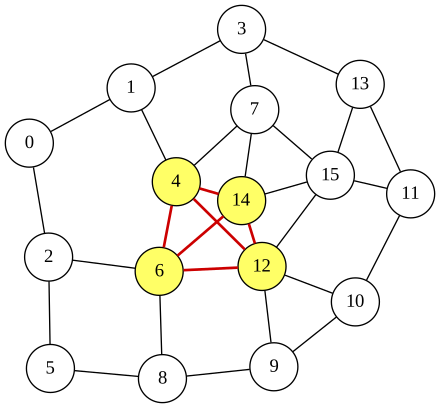
A qbpp::graph::GraphDrawer object graph is created so that the selected clique nodes and clique edges are highlighted.
This program produces the following output:
objective = 4
constraint = 0
From this output, we obtain a maximum clique of 4 nodes without violating the constraint. The result is visualized in maxclique.svg as follows:
最大クリーク問題
無向グラフ $G=(V,E)$ が与えられたとき、最大クリーク問題は、$S$ 内の任意の異なる2頂点が $E$ の辺で結ばれているような最大の部分集合 $S\subseteq V$ を求めることを目的とします。
頂点に $0,1,\ldots,n−1$ のラベルが付いているとします。 $n$ 個のバイナリ変数 $x_0, x_1, \ldots, x_{n-1}$ を導入し、$x_i=1$ はノード $i$ が $S$ に属することを表します ($0\leq i\leq n−1$)。 すると、$S$ のサイズは以下で与えられます:
\[\begin{aligned} \text{objective} &= \sum_{i=0}^{n-1}x_i. \end{aligned}\]$S$ がクリークであるためには、選択されたノードのすべてのペアが辺で結ばれている必要があります。 同等に、$(i,j)\not\in E$ であるすべてのノードペア $i$ と $j$ について、$i$ と $j$ の両方を選択することはできません。 これは以下の制約で表現できます:
\[\begin{aligned} \text{constraint} &= \sum_{(i,j)\not\in E}x_ix_j \end{aligned}\]実行可能なクリークは $constraint=0$ を満たします。 したがって、以下の QUBO 定式化 $f$(最小化対象)が得られます:
\[\begin{aligned} f &= -\text{objective}+2\times \text{constraint} \end{aligned}\]ここで 2 はペナルティ係数です。
$f$ を最小化する最適解は最大クリークに対応し、目的関数の値は選択されたノードの数に等しくなります。
最大クリーク問題の QUBO++ プログラム
上記の定式化に基づき、以下の QUBO++ プログラムは 16 ノードのグラフに対する QUBO 式 $f$ を構築し、Exhaustive Solver を用いて解きます:
#include <qbpp/qbpp.hpp>
#include <qbpp/exhaustive_solver.hpp>
#include <qbpp/graph.hpp>

int main() {
  const size_t N = 16;
  std::vector<std::pair<size_t, size_t>> edges = {
      {0, 1},   {0, 2},   {1, 3},   {1, 4},   {2, 5},   {2, 6},
      {3, 7},   {3, 13},  {4, 6},   {4, 7},   {4, 12},  {4, 14},
      {5, 8},   {6, 8},   {6, 12},  {6, 14},  {7, 14},  {7, 15},
      {8, 9},   {9, 10},  {9, 12},  {10, 11}, {10, 12}, {11, 13},
      {11, 15}, {12, 14}, {12, 15}, {13, 15}, {14, 15}};
  const size_t M = edges.size();

  std::vector<std::vector<bool>> adj(N, std::vector<bool>(N, false));
  for (auto [u, v] : edges) {
    adj[u][v] = adj[v][u] = true;
  }

  auto x = qbpp::var("x", N);

  auto objective = qbpp::sum(x);

  auto constraint = qbpp::Expr(0);
  for (size_t i = 0; i < N; ++i) {
    for (size_t j = i + 1; j < N; ++j) {
      if (!adj[i][j]) {
        constraint += x[i] * x[j];
      }
    }
  }

  auto f = -objective + N * constraint;
  f.simplify_as_binary();

  auto solver = qbpp::exhaustive_solver::ExhaustiveSolver(f);
  auto sol = solver.search();

  std::cout << "objective = " << objective(sol) << std::endl;
  qbpp::graph::GraphDrawer graph;
  for (size_t i = 0; i < N; ++i) {
    graph.add_node(qbpp::graph::Node(i).color(sol(x[i])));
  }
  for (size_t i = 0; i < M; ++i) {
    auto edge = qbpp::graph::Edge(edges[i].first, edges[i].second);
    if (sol(x[edges[i].first]) && sol(x[edges[i].second])) {
      edge.color(1).penwidth(2.0);
    }
    graph.add_edge(edge);
  }
  graph.write("maxclique.svg");
}
辺リスト edges から隣接行列 adj を構築し、与えられたノードペアがグラフの辺を形成するかどうかを判定できるようにします。 N = 16 個のバイナリ変数のベクトル x に対して、上記の QUBO 定式化に従って式 objective、constraint、f を構築します。 特に、adj[i][j] が false の場合、二次項 x[i] * x[j] が constraint に追加されます。
Exhaustive Solver を用いて f を最小化する最適解を求め、sol に格納します。sol における objective と constraint の値が出力されます。
qbpp::graph::GraphDrawer オブジェクト graph を作成し、選択されたクリークのノードと辺を強調表示します。
このプログラムの出力は以下の通りです:
objective = 4
constraint = 0
この出力から、制約を違反することなく 4 ノードの最大クリークが得られたことがわかります。 結果は以下のように maxclique.svg で可視化されます: