Permutation matrix generation
Many combinatorial optimization problems are permutation-based in the sense that the objective is to find an optimal permutation. As a fundamental technique for formulating such optimization problems, a matrix of binary variables is used in their QUBO formulation.
Permutation matrix
Let $X=(x_{i,j})$ ($0\leq i,j\leq n-1$) is a matrix of $n\times n$ binary values. The matrix $X$ is called a permutation matrix if and only if every row and every column has exactly one entry equal to 1, as shown below.
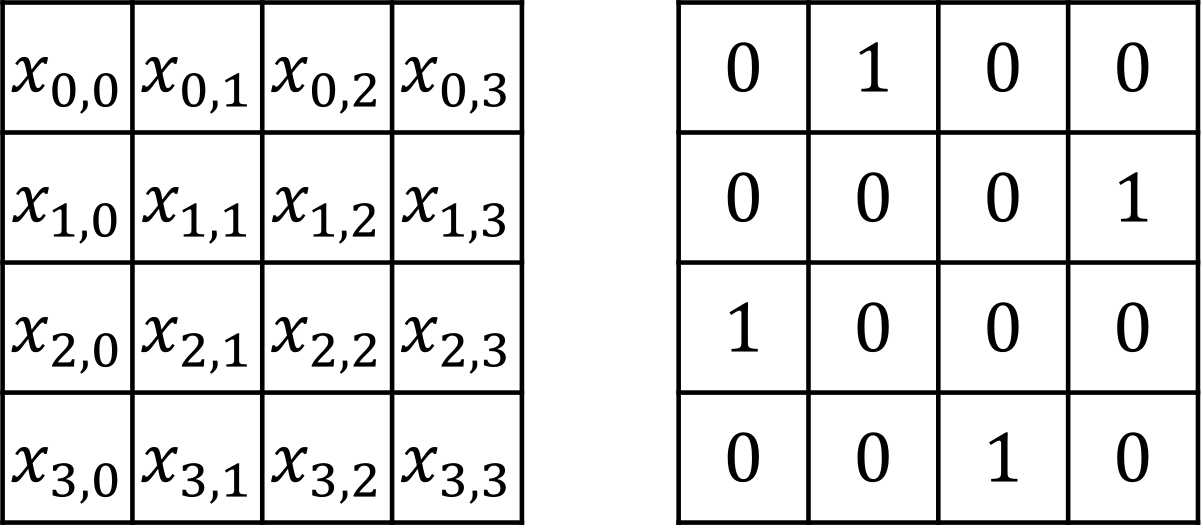
A permutation matrix represents a permutation of $n$ numbers $(0,1,\ldots,n-1)$, where $x_{i,j} = 1$ if and only if the $i$-th element is $j$. For example, the above permutation matrix represents the permutation $(1,3,0,2)$.
QUBO formulation for permutation matrices
A binary variable matrix $X=(x_{i,j})$ ($0\leq i,j\leq n-1$) stores a permutation matrix if and only if the sum of each row and each column is 1. Thus, the following QUBO function takes the minimum value 0 if and only if $X$ stores a permutation matrix:
\[\begin{aligned} f(X) &= \sum_{i=0}^{n-1}\left(1-\sum_{j=0}^{n-1}x_{i,j}\right)^2+\sum_{j=0}^{n-1}\left(1-\sum_{i=0}^{n-1}x_{i,j}\right)^2 \end{aligned}\]QUBO++ program for generating permutation matrices
We can design a QUBO++ program based on the formula $f(X)$ above as follows:
#include <qbpp/qbpp.hpp>
#include <qbpp/exhaustive_solver.hpp>

int main() {
  auto x = qbpp::var("x", 4, 4);
  auto f = qbpp::expr();

  for (size_t i = 0; i < 4; i++) {
    auto s = qbpp::expr();
    for (size_t j = 0; j < 4; j++) {
      s += x[i][j];
    }
    f += qbpp::sqr(1 - s);
  }

  for (size_t j = 0; j < 4; j++) {
    auto s = qbpp::expr();
    for (size_t i = 0; i < 4; i++) {
      s += x[i][j];
    }
    f += qbpp::sqr(1 - s);
  }

  f.simplify_as_binary();
  auto solver = qbpp::exhaustive_solver::ExhaustiveSolver(f);
  auto sols = solver.search({{"best_energy_sols", 1}});
  for (size_t k = 0; k < sols.size(); k++) {
    const auto& sol = sols[k];
    std::cout << "Solution " << k << " : " << sol(x) << std::endl;
  }
}
In this program, qbpp::var("x",4,4) returns a qbpp::Array<2, qbpp::Var> object of shape ${4, 4}$ named x. For a qbpp::Expr object f, two double for-loops adds formulas for $f(X)$. Using the Exhaustive Solver, all optimal solutions are computed and stored in sols. All solutions in sols are displayed one-by-one. Here, sol(x) returns a matrix of values of x in sol. This program outputs all 24 permutations as follows:
Solution 0 : {{0,0,0,1},{0,0,1,0},{0,1,0,0},{1,0,0,0}}
Solution 1 : {{0,0,0,1},{0,0,1,0},{1,0,0,0},{0,1,0,0}}
Solution 2 : {{0,0,0,1},{0,1,0,0},{0,0,1,0},{1,0,0,0}}
Solution 3 : {{0,0,0,1},{0,1,0,0},{1,0,0,0},{0,0,1,0}}
Solution 4 : {{0,0,0,1},{1,0,0,0},{0,0,1,0},{0,1,0,0}}
Solution 5 : {{0,0,0,1},{1,0,0,0},{0,1,0,0},{0,0,1,0}}
Solution 6 : {{0,0,1,0},{0,0,0,1},{0,1,0,0},{1,0,0,0}}
Solution 7 : {{0,0,1,0},{0,0,0,1},{1,0,0,0},{0,1,0,0}}
Solution 8 : {{0,0,1,0},{0,1,0,0},{0,0,0,1},{1,0,0,0}}
Solution 9 : {{0,0,1,0},{0,1,0,0},{1,0,0,0},{0,0,0,1}}
Solution 10 : {{0,0,1,0},{1,0,0,0},{0,0,0,1},{0,1,0,0}}
Solution 11 : {{0,0,1,0},{1,0,0,0},{0,1,0,0},{0,0,0,1}}
Solution 12 : {{0,1,0,0},{0,0,0,1},{0,0,1,0},{1,0,0,0}}
Solution 13 : {{0,1,0,0},{0,0,0,1},{1,0,0,0},{0,0,1,0}}
Solution 14 : {{0,1,0,0},{0,0,1,0},{0,0,0,1},{1,0,0,0}}
Solution 15 : {{0,1,0,0},{0,0,1,0},{1,0,0,0},{0,0,0,1}}
Solution 16 : {{0,1,0,0},{1,0,0,0},{0,0,0,1},{0,0,1,0}}
Solution 17 : {{0,1,0,0},{1,0,0,0},{0,0,1,0},{0,0,0,1}}
Solution 18 : {{1,0,0,0},{0,0,0,1},{0,0,1,0},{0,1,0,0}}
Solution 19 : {{1,0,0,0},{0,0,0,1},{0,1,0,0},{0,0,1,0}}
Solution 20 : {{1,0,0,0},{0,0,1,0},{0,0,0,1},{0,1,0,0}}
Solution 21 : {{1,0,0,0},{0,0,1,0},{0,1,0,0},{0,0,0,1}}
Solution 22 : {{1,0,0,0},{0,1,0,0},{0,0,0,1},{0,0,1,0}}
Solution 23 : {{1,0,0,0},{0,1,0,0},{0,0,1,0},{0,0,0,1}}
NOTE A matrix of binary variables is implemented as a multi-dimensional array using
qbpp::Arrayclass. For example,qbpp::var("x",4,4)returns aqbpp::Array<2, qbpp::Var>object with shape {4,4}. Eachqbpp::Varobject is represented asx[i][j]and the value ofx[i][j]forsolcan be obtained by eithersol(x[i][j])orx[i][j](sol).
QUBO formulation for a permutation matrix using array functions and operations
Using qbpp::vector_sum(), we can compute the row-wise and column-wise sums of a matrix x of binary variables:
qbpp::vector_sum(x, 1): Computes the sum of each row ofxand returns an array of sizencontaining these sums.qbpp::vector_sum(x, 0): Computes the sum of each column ofxand returns an array of sizencontaining these sums.
Note: For a multi-dimensional array
xand an axisk,qbpp::vector_sum(x, k)computes sums along axiskand returns a multi-dimensional array whose dimension is reduced by one. For a 2-dimensional array (matrix)x, axis1corresponds to the row direction, and axis0corresponds to the column direction.
A scalar-array operation can be used to subtract 1 from each element:
qbpp::vector_sum(x, 1) - 1: subtracts 1 from each row-wise sum.qbpp::vector_sum(x, 0) - 1: subtracts 1 from each column-wise sum.
For these two arrays of size n, qbpp::sqr() squares each element, and qbpp::sum() computes the sum of all elements.
The following QUBO++ program implements a QUBO formulation using these array functions and operations:
#include <qbpp/qbpp.hpp>
#include <qbpp/exhaustive_solver.hpp>

int main() {
  auto x = qbpp::var("x", 4, 4);
  auto f = qbpp::sum(qbpp::sqr(qbpp::vector_sum(x, 1) - 1)) +
           qbpp::sum(qbpp::sqr(qbpp::vector_sum(x, 0) - 1));
  f.simplify_as_binary();
  auto solver = qbpp::exhaustive_solver::ExhaustiveSolver(f);
  auto sols = solver.search({{"best_energy_sols", 1}});
  for (size_t k = 0; k < sols.size(); k++) {
    const auto& sol = sols[k];
    const auto& row = qbpp::onehot_to_int(x(sol), 1);
    const auto& column = qbpp::onehot_to_int(x(sol), 0);
    std::cout << "Solution " << k << ": " << row << ", " << column << std::endl;
  }
}
In this program, x(sol) returns a matrix of assigned values to x in sol, which is a matrix of integers of size . qbpp::onehot_to_int() converts one-hot arrays along the axis to the corresponding integers.
qbpp::onehot_to_int(x(sol), 1): Computes the integer corresponding to each row and returns them as an array of 4 integers, which represents the permutation.qbpp::onehot_to_int(x(sol), 0): returns the integer corresponding to each column and returns them as an array of 4 integers, which represents the inverse of the permutation. This program outputs all permutations and their inverse as integer vectors as follows:Solution 0: {3,2,1,0}, {3,2,1,0} Solution 1: {3,2,0,1}, {2,3,1,0} Solution 2: {3,1,2,0}, {3,1,2,0} Solution 3: {3,1,0,2}, {2,1,3,0} Solution 4: {3,0,2,1}, {1,3,2,0} Solution 5: {3,0,1,2}, {1,2,3,0} Solution 6: {2,3,1,0}, {3,2,0,1} Solution 7: {2,3,0,1}, {2,3,0,1} Solution 8: {2,1,3,0}, {3,1,0,2} Solution 9: {2,1,0,3}, {2,1,0,3} Solution 10: {2,0,3,1}, {1,3,0,2} Solution 11: {2,0,1,3}, {1,2,0,3} Solution 12: {1,3,2,0}, {3,0,2,1} Solution 13: {1,3,0,2}, {2,0,3,1} Solution 14: {1,2,3,0}, {3,0,1,2} Solution 15: {1,2,0,3}, {2,0,1,3} Solution 16: {1,0,3,2}, {1,0,3,2} Solution 17: {1,0,2,3}, {1,0,2,3} Solution 18: {0,3,2,1}, {0,3,2,1} Solution 19: {0,3,1,2}, {0,2,3,1} Solution 20: {0,2,3,1}, {0,3,1,2} Solution 21: {0,2,1,3}, {0,2,1,3} Solution 22: {0,1,3,2}, {0,1,3,2} Solution 23: {0,1,2,3}, {0,1,2,3}
Assignment problem and its QUBO formulation
Let $C = (c_{i,j})$ be a cost matrix of size $n \times n$. The assignment problem for $C$ is to find a permutation $p:\lbrace 0,1,\ldots, n-1\rbrace \rightarrow \lbrace 0,1,\ldots, n-1\rbrace$ that minimizes the total cost:
\[\begin{aligned} g(p) &= \sum_{i=0}^{n-1}c_{i,p(i)} \end{aligned}\]We can use a permutation matrix $X = (x_{i,j})$ of size $n \times n$ for a QUBO formulation of this problem by defining:
\[\begin{aligned} g(X) &= \sum_{i=0}^{n-1}\sum_{j=0}^{n-1}c_{i,j}x_{i,j} \end{aligned}\]Clearly, $g(p) = g(X)$ holds if and only if $X$ represents the permutation $p$.
We combine the QUBO formulation for the permutation matrix, $f(X)$, and the total cost, $g(X)$, to obtain a QUBO formulation of the assignment problem:
\[\begin{aligned} h(X) &= P\cdot f(x)+g(x) \\ &=P\left(\sum_{i=0}^{n-1}\left(1-\sum_{j=0}^{n-1}x_{i,j}\right)^2+\sum_{j=0}^{n-1}\left(1-\sum_{i=0}^{n-1}x_{i,j}\right)^2\right)+\sum_{i=0}^{n-1}\sum_{j=0}^{n-1}c_{i,j}x_{i,j} \end{aligned}\]Here, $P$ is a sufficiently large positive constant that prioritizes the permutation constraints encoded in $f(X)$.
QUBO++ program for the assignment problem
We are now ready to design a QUBO++ program for the assignment problem. In this program, a fixed matrix $C$ of size $4\times4$ is given as a qbpp::Array. The formulas for $f(X)$ and $g(X)$ are defined using array functions and operations. Here, qbpp::vector_sum(x, 1) == 1 returns a QUBO expression that takes the minimum value 0 if the equality is satisfied. In fact, it returns the same QUBO expression as qbpp::sqr(qbpp::vector_sum(x, 1) - 1). Also, c * x returns a matrix obtained by computing the element-wise product of c and x, and therefore qbpp::sum(c * x) returns g(X).
#include <qbpp/qbpp.hpp>
#include <qbpp/easy_solver.hpp>

int main() {
  auto c = qbpp::int_array({{58, 73, 91, 44}, {62, 15, 87, 39}, {78, 56, 23, 94}, {11, 85, 68, 72}});
  auto x = qbpp::var("x", 4, 4);
  auto f = qbpp::sum(qbpp::vector_sum(x, 1) == 1) +
           qbpp::sum(qbpp::vector_sum(x, 0) == 1);
  auto g = qbpp::sum(c * x);
  auto h = 1000 * f + g;
  h.simplify_as_binary();

  auto solver = qbpp::easy_solver::EasySolver(h);
  auto sol = solver.search({{"time_limit", 1.0}});
  std::cout << "sol = " << sol << std::endl;
  auto result = qbpp::onehot_to_int(x(sol), 1);
  std::cout << "Result : " << result << std::endl;
  for (size_t i = 0; i < result.size(); ++i) {
    std::cout << "c[" << i << "][" << result[i] << "] = " << c[i][result[i]]
              << std::endl;
  }
}
We use the Easy Solver to find a solution of h. For an Easy Solver object solver for h, the time limit for searching a solution is set to 1.0 seconds by passing {{"time_limit", 1.0}} to search(). The resulting permutation is stored in result, and the selected c[i][j] values are printed in turn. The output of this program is as follows:
sol = 93:{{x[0][0],0},{x[0][1],0},{x[0][2],0},{x[0][3],1},{x[1][0],0},{x[1][1],1},{x[1][2],0},{x[1][3],0},{x[2][0],0},{x[2][1],0},{x[2][2],1},{x[2][3],0},{x[3][0],1},{x[3][1],0},{x[3][2],0},{x[3][3],0}}
Result : {3,1,2,0}
c[0][3] = 44
c[1][1] = 15
c[2][2] = 23
c[3][0] = 11
NOTE For an expression
fand an integerm,f == mreturns an expressionqbpp::sqr(f - m), which takes the minimum value 0 if and only if the equalityf == mis satisfied.
置換行列の生成
多くの組合せ最適化問題は、最適な置換を見つけることが目的であるという意味で置換ベースです。 このような最適化問題を定式化する基本的な手法として、QUBO定式化ではバイナリ変数の行列が使用されます。
置換行列
$X=(x_{i,j})$ ($0\leq i,j\leq n-1$) を $n\times n$ のバイナリ値の行列とします。 行列 $X$ は、以下に示すように、すべての行とすべての列にちょうど1つの1のエントリがある場合にのみ置換行列と呼ばれます。
置換行列は $n$ 個の数 $(0,1,\ldots,n-1)$ の置換を表し、$x_{i,j} = 1$ であるのは $i$ 番目の要素が $j$ である場合に限ります。 例えば、上記の置換行列は置換 $(1,3,0,2)$ を表しています。
置換行列のQUBO定式化
バイナリ変数行列 $X=(x_{i,j})$ ($0\leq i,j\leq n-1$) が置換行列を格納するのは、各行と各列の和が1である場合に限ります。 したがって、以下のQUBO関数は $X$ が置換行列を格納する場合にのみ最小値0を取ります:
\[\begin{aligned} f(X) &= \sum_{i=0}^{n-1}\left(1-\sum_{j=0}^{n-1}x_{i,j}\right)^2+\sum_{j=0}^{n-1}\left(1-\sum_{i=0}^{n-1}x_{i,j}\right)^2 \end{aligned}\]置換行列を生成するQUBO++プログラム
上記の式 $f(X)$ に基づいて、以下のようにQUBO++プログラムを設計できます:
#include <qbpp/qbpp.hpp>
#include <qbpp/exhaustive_solver.hpp>

int main() {
  auto x = qbpp::var("x", 4, 4);
  auto f = qbpp::expr();

  for (size_t i = 0; i < 4; i++) {
    auto s = qbpp::expr();
    for (size_t j = 0; j < 4; j++) {
      s += x[i][j];
    }
    f += qbpp::sqr(1 - s);
  }

  for (size_t j = 0; j < 4; j++) {
    auto s = qbpp::expr();
    for (size_t i = 0; i < 4; i++) {
      s += x[i][j];
    }
    f += qbpp::sqr(1 - s);
  }

  f.simplify_as_binary();
  auto solver = qbpp::exhaustive_solver::ExhaustiveSolver(f);
  auto sols = solver.search({{"best_energy_sols", 1}});
  for (size_t k = 0; k < sols.size(); k++) {
    const auto& sol = sols[k];
    std::cout << "Solution " << k << " : " << sol(x) << std::endl;
  }
}
このプログラムでは、qbpp::var("x",4,4)はxという名前の形状 ${4, 4}$ の qbpp::Array<2, qbpp::Var> オブジェクトを返します。 qbpp::Expr オブジェクトfに対して、2つの二重forループが $f(X)$ の式を追加します。 Exhaustive Solverを使用して、すべての最適解が計算されsolsに格納されます。 sols 内のすべての解が1つずつ表示されます。 ここで、sol(x) は sol における x の値の行列を返します。 このプログラムは以下のように24個すべての置換を出力します:
Solution 0 : {{0,0,0,1},{0,0,1,0},{0,1,0,0},{1,0,0,0}}
Solution 1 : {{0,0,0,1},{0,0,1,0},{1,0,0,0},{0,1,0,0}}
Solution 2 : {{0,0,0,1},{0,1,0,0},{0,0,1,0},{1,0,0,0}}
Solution 3 : {{0,0,0,1},{0,1,0,0},{1,0,0,0},{0,0,1,0}}
Solution 4 : {{0,0,0,1},{1,0,0,0},{0,0,1,0},{0,1,0,0}}
Solution 5 : {{0,0,0,1},{1,0,0,0},{0,1,0,0},{0,0,1,0}}
Solution 6 : {{0,0,1,0},{0,0,0,1},{0,1,0,0},{1,0,0,0}}
Solution 7 : {{0,0,1,0},{0,0,0,1},{1,0,0,0},{0,1,0,0}}
Solution 8 : {{0,0,1,0},{0,1,0,0},{0,0,0,1},{1,0,0,0}}
Solution 9 : {{0,0,1,0},{0,1,0,0},{1,0,0,0},{0,0,0,1}}
Solution 10 : {{0,0,1,0},{1,0,0,0},{0,0,0,1},{0,1,0,0}}
Solution 11 : {{0,0,1,0},{1,0,0,0},{0,1,0,0},{0,0,0,1}}
Solution 12 : {{0,1,0,0},{0,0,0,1},{0,0,1,0},{1,0,0,0}}
Solution 13 : {{0,1,0,0},{0,0,0,1},{1,0,0,0},{0,0,1,0}}
Solution 14 : {{0,1,0,0},{0,0,1,0},{0,0,0,1},{1,0,0,0}}
Solution 15 : {{0,1,0,0},{0,0,1,0},{1,0,0,0},{0,0,0,1}}
Solution 16 : {{0,1,0,0},{1,0,0,0},{0,0,0,1},{0,0,1,0}}
Solution 17 : {{0,1,0,0},{1,0,0,0},{0,0,1,0},{0,0,0,1}}
Solution 18 : {{1,0,0,0},{0,0,0,1},{0,0,1,0},{0,1,0,0}}
Solution 19 : {{1,0,0,0},{0,0,0,1},{0,1,0,0},{0,0,1,0}}
Solution 20 : {{1,0,0,0},{0,0,1,0},{0,0,0,1},{0,1,0,0}}
Solution 21 : {{1,0,0,0},{0,0,1,0},{0,1,0,0},{0,0,0,1}}
Solution 22 : {{1,0,0,0},{0,1,0,0},{0,0,0,1},{0,0,1,0}}
Solution 23 : {{1,0,0,0},{0,1,0,0},{0,0,1,0},{0,0,0,1}}
NOTE バイナリ変数の行列は
qbpp::Arrayクラスを使用した多次元配列として実装されています。 例えば、qbpp::var("x",4,4)は形状 {4,4} のqbpp::Array<2, qbpp::Var>オブジェクトを返します。 各qbpp::Varオブジェクトはx[i][j]として表され、solにおけるx[i][j]の値はsol(x[i][j])またはx[i][j](sol)のいずれかで取得できます。
配列関数と演算を使った置換行列のQUBO定式化
qbpp::vector_sum() を使用して、バイナリ変数の行列 x の行方向と列方向の和を計算できます:
qbpp::vector_sum(x, 1):xの各行の和を計算し、それらの和を含むサイズnの配列を返します。qbpp::vector_sum(x, 0):xの各列の和を計算し、それらの和を含むサイズnの配列を返します。
Note: 多次元配列
xと軸kに対して、qbpp::vector_sum(x, k)は軸kに沿った和を計算し、次元が1つ減った多次元配列を返します。 2次元配列(行列)xの場合、軸1は行方向に、軸0は列方向に対応します。
スカラー-配列演算を使用して、各要素から1を引くことができます:
qbpp::vector_sum(x, 1) - 1: 行方向の各和から1を引きます。qbpp::vector_sum(x, 0) - 1: 列方向の各和から1を引きます。
これら2つのサイズ n の配列に対して、qbpp::sqr() は各要素を2乗し、qbpp::sum() はすべての要素の和を計算します。
以下のQUBO++プログラムは、これらの配列関数と演算を使用してQUBO定式化を実装しています:
#include <qbpp/qbpp.hpp>
#include <qbpp/exhaustive_solver.hpp>

int main() {
  auto x = qbpp::var("x", 4, 4);
  auto f = qbpp::sum(qbpp::sqr(qbpp::vector_sum(x, 1) - 1)) +
           qbpp::sum(qbpp::sqr(qbpp::vector_sum(x, 0) - 1));
  f.simplify_as_binary();
  auto solver = qbpp::exhaustive_solver::ExhaustiveSolver(f);
  auto sols = solver.search({{"best_energy_sols", 1}});
  for (size_t k = 0; k < sols.size(); k++) {
    const auto& sol = sols[k];
    const auto& row = qbpp::onehot_to_int(x(sol), 1);
    const auto& column = qbpp::onehot_to_int(x(sol), 0);
    std::cout << "Solution " << k << ": " << row << ", " << column << std::endl;
  }
}
このプログラムでは、x(sol) は sol における x に割り当てられた値の行列を返します。これは整数のサイズの行列です。 qbpp::onehot_to_int() は軸に沿ったone-hot配列を対応する整数に変換します。
qbpp::onehot_to_int(x(sol), 1): 各行に対応する整数を計算し、4つの整数の配列として返します。これが置換を表します。qbpp::onehot_to_int(x(sol), 0): 各列に対応する整数を返し、4つの整数の配列として返します。これが置換の逆を表します。 このプログラムはすべての置換とその逆を整数ベクトルとして以下のように出力します:Solution 0: {3,2,1,0}, {3,2,1,0} Solution 1: {3,2,0,1}, {2,3,1,0} Solution 2: {3,1,2,0}, {3,1,2,0} Solution 3: {3,1,0,2}, {2,1,3,0} Solution 4: {3,0,2,1}, {1,3,2,0} Solution 5: {3,0,1,2}, {1,2,3,0} Solution 6: {2,3,1,0}, {3,2,0,1} Solution 7: {2,3,0,1}, {2,3,0,1} Solution 8: {2,1,3,0}, {3,1,0,2} Solution 9: {2,1,0,3}, {2,1,0,3} Solution 10: {2,0,3,1}, {1,3,0,2} Solution 11: {2,0,1,3}, {1,2,0,3} Solution 12: {1,3,2,0}, {3,0,2,1} Solution 13: {1,3,0,2}, {2,0,3,1} Solution 14: {1,2,3,0}, {3,0,1,2} Solution 15: {1,2,0,3}, {2,0,1,3} Solution 16: {1,0,3,2}, {1,0,3,2} Solution 17: {1,0,2,3}, {1,0,2,3} Solution 18: {0,3,2,1}, {0,3,2,1} Solution 19: {0,3,1,2}, {0,2,3,1} Solution 20: {0,2,3,1}, {0,3,1,2} Solution 21: {0,2,1,3}, {0,2,1,3} Solution 22: {0,1,3,2}, {0,1,3,2} Solution 23: {0,1,2,3}, {0,1,2,3}
割当問題とそのQUBO定式化
$C = (c_{i,j})$ をサイズ $n \times n$ のコスト行列とします。 $C$ に対する割当問題は、総コストを最小化する置換 $p:\lbrace 0,1,\ldots, n-1\rbrace \rightarrow \lbrace 0,1,\ldots, n-1\rbrace$ を見つけることです:
\[\begin{aligned} g(p) &= \sum_{i=0}^{n-1}c_{i,p(i)} \end{aligned}\]この問題のQUBO定式化には、サイズ $n \times n$ の置換行列 $X = (x_{i,j})$ を使用して以下のように定義できます:
\[\begin{aligned} g(X) &= \sum_{i=0}^{n-1}\sum_{j=0}^{n-1}c_{i,j}x_{i,j} \end{aligned}\]明らかに、$X$ が置換 $p$ を表す場合にのみ $g(p) = g(X)$ が成り立ちます。
置換行列のQUBO定式化 $f(X)$ と総コスト $g(X)$ を組み合わせて、割当問題のQUBO定式化を得ます:
\[\begin{aligned} h(X) &= P\cdot f(x)+g(x) \\ &=P\left(\sum_{i=0}^{n-1}\left(1-\sum_{j=0}^{n-1}x_{i,j}\right)^2+\sum_{j=0}^{n-1}\left(1-\sum_{i=0}^{n-1}x_{i,j}\right)^2\right)+\sum_{i=0}^{n-1}\sum_{j=0}^{n-1}c_{i,j}x_{i,j} \end{aligned}\]ここで、$P$ は $f(X)$ にエンコードされた置換制約を優先するための十分に大きな正の定数です。
割当問題のQUBO++プログラム
これで割当問題のQUBO++プログラムを設計する準備が整いました。 このプログラムでは、サイズ $4\times4$ の固定行列 $C$ が qbpp::Array として与えられます。 $f(X)$ と $g(X)$ の式は配列関数と演算を使用して定義されます。 ここで、qbpp::vector_sum(x, 1) == 1 は等式が満たされた場合に最小値0を取るQUBO式を返します。 実際には、qbpp::sqr(qbpp::vector_sum(x, 1) - 1) と同じQUBO式を返します。 また、c * x は c と x の要素ごとの積を計算して得られる行列を返すため、qbpp::sum(c * x) は g(X) を返します。
#include <qbpp/qbpp.hpp>
#include <qbpp/easy_solver.hpp>

int main() {
  auto c = qbpp::int_array({{58, 73, 91, 44}, {62, 15, 87, 39}, {78, 56, 23, 94}, {11, 85, 68, 72}});
  auto x = qbpp::var("x", 4, 4);
  auto f = qbpp::sum(qbpp::vector_sum(x, 1) == 1) +
           qbpp::sum(qbpp::vector_sum(x, 0) == 1);
  auto g = qbpp::sum(c * x);
  auto h = 1000 * f + g;
  h.simplify_as_binary();

  auto solver = qbpp::easy_solver::EasySolver(h);
  auto sol = solver.search({{"time_limit", 1.0}});
  std::cout << "sol = " << sol << std::endl;
  auto result = qbpp::onehot_to_int(x(sol), 1);
  std::cout << "Result : " << result << std::endl;
  for (size_t i = 0; i < result.size(); ++i) {
    std::cout << "c[" << i << "][" << result[i] << "] = " << c[i][result[i]]
              << std::endl;
  }
}
Easy Solverを使用して h の解を求めます。 h に対するEasy Solverオブジェクト solver について、search() に {{"time_limit", 1.0}} を渡して解の探索の制限時間を1.0秒に設定します。 得られた置換は result に格納され、選択された c[i][j] の値が順に出力されます。 このプログラムの出力は以下のとおりです:
sol = 93:{{x[0][0],0},{x[0][1],0},{x[0][2],0},{x[0][3],1},{x[1][0],0},{x[1][1],1},{x[1][2],0},{x[1][3],0},{x[2][0],0},{x[2][1],0},{x[2][2],1},{x[2][3],0},{x[3][0],1},{x[3][1],0},{x[3][2],0},{x[3][3],0}}
Result : {3,1,2,0}
c[0][3] = 44
c[1][1] = 15
c[2][2] = 23
c[3][0] = 11
NOTE 式
fと整数mに対して、f == mは式qbpp::sqr(f - m)を返します。 これは等式f == mが満たされる場合にのみ最小値0を取ります。