Subgraph Isomorphism Problem
Given two undirected graphs $G_H=(V_H,E_H)$ (the host graph) and $G_G=(V_G,E_G)$ (the guest graph), the subgraph isomorphism problem asks whether $G_H$ contains a subgraph that is isomorphic to $G_G$.
More formally, the goal is to find an injective mapping $\sigma:V_G\rightarrow V_H$ such that, for every edge $(u,v)\in E_G$, the pair $(\sigma(u),\sigma(v))$ is also an edge of the host graph, i.e., $(\sigma(u),\sigma(v))\in E_H$.
For example, consider the following host and guest graphs:
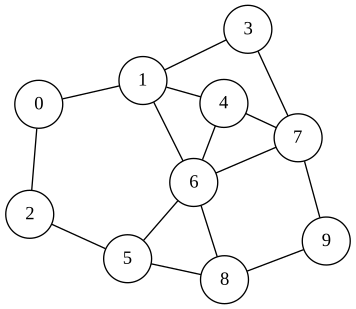
An example of the host graph $G_H=(V_H,E_H)$ with 10 nodes
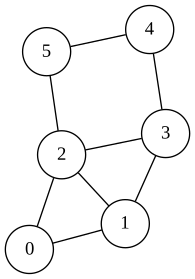
An example of the guest graph $G_G=(V_G,E_G)$ with 6 nodes
One solution $\sigma$ is:
| node $i$ in $G_G$ | 0 | 1 | 2 | 3 | 4 | 5 |
|---|---|---|---|---|---|---|
| node $\sigma(i)$ in $G_H$ | 1 | 4 | 6 | 7 | 9 | 8 |
This solution is visualized as follows:
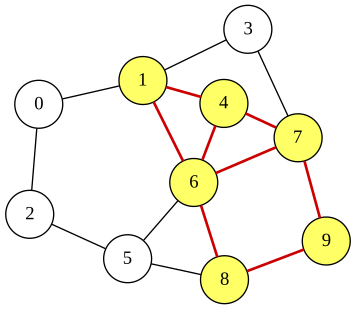
A solution to the subgraph isomorphism problem
QUBO formulation of the subgraph isomorphic problem
Assume that the guest graph $G_G=(V_G,E_G)$ has $m$ nodes labeled $0, 1, \ldots m-1$, and and the host graph $G_H=(V_H,E_H) $ has $n$ nodes labeled $0, 1, \ldots n-1$. We introduce an $m\times n$ binary matrix $X=(x_{i,j})$ ($0\leq i\leq m-1, 0\leq j\leq n-1$) with $mn$ binary variables. This matrix represents an injective mapping $\sigma:V_G\rightarrow V_H$ such that $x_{i,j}=1$ if and only if $\sigma(i)=j$.
For example, the solution of the subgraph isomorphism problem can be represented by the following $6\times 10$ binary matrix:
| $i$ | $\sigma(i)$ | 0 | 1 | 2 | 3 | 4 | 5 | 6 | 7 | 8 | 9 |
|---|---|---|---|---|---|---|---|---|---|---|---|
| 0 | 1 | 0 | 1 | 0 | 0 | 0 | 0 | 0 | 0 | 0 | 0 |
| 1 | 4 | 0 | 0 | 0 | 0 | 1 | 0 | 0 | 0 | 0 | 0 |
| 2 | 6 | 0 | 0 | 0 | 0 | 0 | 0 | 1 | 0 | 0 | 0 |
| 3 | 7 | 0 | 0 | 0 | 0 | 0 | 0 | 0 | 1 | 0 | 0 |
| 4 | 9 | 0 | 0 | 0 | 0 | 0 | 0 | 0 | 0 | 0 | 1 |
| 5 | 8 | 0 | 0 | 0 | 0 | 0 | 0 | 0 | 0 | 1 | 0 |
Because $X$ represents an injective mapping, it must satisfy the following constraints:
- Row constraint: Each guest node is mapped to exactly one host node, i.e., the sum of each row is 1.
- Column constraint: Each host node is used by at most one guest node, i.e., the sum of each column is 0 or 1.
These can be combined into the following QUBO++-style constraint, which attains its minimum value when all constraints are satisfied:
\[\begin{aligned} \text{constraint} &= \sum_{i=0}^{m-1}\Bigl(\sum_{j=0}^{n-1}x_{i,j} = 1\Bigr)+\sum_{j=0}^{m-1}\Bigl(0\leq \sum_{i=0}^{n-1}x_{i,j} \leq 1\Bigr) \end{aligned}\]In QUBO form, we can express the same constraints as:
\[\begin{aligned} \text{constraint} &= \sum_{i=0}^{m-1}\Bigl(\sum_{j=0}^{n-1}x_{i,j} - 1\Bigr)^2+\sum_{j=0}^{m-1}\sum_{i=0}^{n-1}x_{i,j}\Bigl(\sum_{i=0}^{n-1}x_{i,j}-1\Bigr) \end{aligned}\]Next, we define the objective as the number of guest edges that are mapped to host edges:
\[\begin{aligned} \text{objective} &= \sum_{(u_G,v_G)\in E_G}\sum_{(u_H,v_H)\in E_H} (x_{u_G,u_H}x_{v_G,v_H}+x_{u_G,v_H}x_{v_G,u_H}) \end{aligned}\]Here, an undirected guest edge $(u_G,v_G)\in E_G$ can correspond to a host edge $(u_H,v_H)\in E_H$ in two symmetric ways:
- $(u_G, v_G)\mapsto (u_H,v_H)$
- $(u_G, v_G)\mapsto (v_H,u_H)$
Therefore, we include both quadratic terms $x_{u_G,u_H}x_{v_G,v_H}$ and $x_{u_G,v_H}x_{v_G,u_H}$.
Finally, we combine the objective and the constraint into a single QUBO expression:
\[\begin{aligned} f &= -\text{objective} + mn\times \text{constraint} \end{aligned}\]The penalty coefficient $mn$ is chosen so that satisfying the constraints is prioritized over improving the objective. The best possible value of $f$ is attained when the constraint term is zero and the objective equals the number of guest edges.
QUBO++ program of the subgraph isomorphic problem
Based on the QUBO formulation above, the following QUBO++ program solves the subgraph isomorphism problem for a guest graph with $M=6$ nodes and a host graph with $N=10$ nodes:
#include <qbpp/qbpp.hpp>
#include <qbpp/easy_solver.hpp>
#include <qbpp/graph.hpp>

int main() {
  const size_t N = 10;
  std::vector<std::pair<size_t, size_t>> host = {
      {0, 1}, {0, 2}, {1, 3}, {1, 4}, {1, 6}, {2, 5}, {3, 7}, {4, 6},
      {4, 7}, {5, 6}, {5, 8}, {6, 8}, {6, 7}, {7, 9}, {8, 9}};

  const size_t M = 6;
  std::vector<std::pair<size_t, size_t>> guest = {
      {0, 1}, {0, 2}, {1, 2}, {1, 3}, {2, 3}, {2, 5}, {3, 4}, {4, 5}};

  auto x = qbpp::var("x", M, N);

  auto host_assigned = qbpp::vector_sum(x, 0);

  auto constraint = qbpp::sum(qbpp::vector_sum(x, 1) == 1) +
                    qbpp::sum(0 <= host_assigned <= 1);

  auto objective = qbpp::toExpr(0);

  for (const auto& e_g : guest) {
    for (const auto& e_h : host) {
      objective += x[e_g.first][e_h.first] * x[e_g.second][e_h.second] +
                   x[e_g.first][e_h.second] * x[e_g.second][e_h.first];
    }
  }

  auto f = -objective + constraint * (M * N);

  f.simplify_as_binary();

  auto solver = qbpp::easy_solver::EasySolver(f);
  auto sol = solver.search({{"target_energy", std::to_string(-static_cast<int>(guest.size()))}});

  std::cout << "sol(x) = " << sol(x) << std::endl;

  std::cout << "sol(objective) = " << sol(objective) << std::endl;
  std::cout << "sol(constraint) = " << sol(constraint) << std::endl;

  auto guest_to_host = qbpp::onehot_to_int(sol(x), 1);
  std::cout << "guest_to_host = " << guest_to_host << std::endl;

  auto host_to_guest = qbpp::onehot_to_int(sol(x), 0);
  std::cout << "host_to_guest = " << host_to_guest << std::endl;

  qbpp::graph::GraphDrawer guest_graph;
  for (size_t i = 0; i < M; ++i) {
    guest_graph.add(qbpp::graph::Node(i));
  }
  for (const auto& e : guest) {
    guest_graph.add(qbpp::graph::Edge(e.first, e.second));
  }
  guest_graph.write("guest_graph.svg");

  qbpp::graph::GraphDrawer host_graph;
  for (size_t i = 0; i < N; ++i) {
    host_graph.add(qbpp::graph::Node(i));
  }
  for (const auto& e : host) {
    host_graph.add(qbpp::graph::Edge(e.first, e.second));
  }
  host_graph.write("host_graph.svg");

  qbpp::graph::GraphDrawer graph;
  for (size_t i = 0; i < N; ++i) {
    graph.add(qbpp::graph::Node(i).color(sol(host_assigned[i])));
  }

  std::vector<std::vector<bool>> guest_adj(N, std::vector<bool>(N, false));
  for (auto [u, v] : guest) {
    guest_adj[u][v] = guest_adj[v][u] = true;
  }
  for (const auto& e_h : host) {
    auto u = host_to_guest[e_h.first];
    auto v = host_to_guest[e_h.second];
    if (u != -1 && v != -1 &&
        guest_adj[static_cast<size_t>(u)][static_cast<size_t>(v)]) {
      graph.add(
          qbpp::graph::Edge(e_h.first, e_h.second).color(1).penwidth(2.0f));
    } else {
      graph.add(qbpp::graph::Edge(e_h.first, e_h.second));
    }
  }

  graph.write("subgraph_isomorphism.svg");
}
The guest and host graphs are given as the edge lists guest and host, respectively. We define an $M\times N$ binary matrix x, and then construct the expressions constraint, objective, and f according to the formulation above.
An Easy Solver instance is created for f, and the target energy is set to $−∣E_G|$ (the negative number of guest edges), which is the best possible value of -objective when all guest edges are mapped to host edges. The obtained solution is stored in sol. The values of x, objective, and constraint under sol are then printed.
Using the function qbpp::onehot_to_int(), the program also outputs the mappings from guest nodes to host nodes (guest_to_host, $\sigma$) and from host nodes to guest nodes (host_to_guest,$\sigma^{-1}$).
The guest and host graphs are saved as guest_graph.svg and host_graph.svg, respectively. Finally, the solution is visualized in subgraph_isomorphism.svg, where the host nodes selected by the mapping and the host edges corresponding to guest edges are highlighted.
This program produces the following output:
sol(x) = {{0,1,0,0,0,0,0,0,0,0},{0,0,0,0,1,0,0,0,0,0},{0,0,0,0,0,0,1,0,0,0},{0,0,0,0,0,0,0,1,0,0},{0,0,0,0,0,0,0,0,0,1},{0,0,0,0,0,0,0,0,1,0}}
sol(objective) = 8
sol(constraint) = 0
guest_to_host = {1,4,6,7,9,8}
host_to_guest = {-1,0,-1,-1,1,-1,2,3,5,4}
The objective value equals the number of guest edges ($|E_G|=8$), and all constraints are satisfied (constraint = 0). Therefore, the program finds an optimal solution that corresponds to a valid subgraph isomorphism. Note that an entry of host_to_guest is -1 if the corresponding host node is not mapped from any guest node.
部分グラフ同型問題
2つの無向グラフ $G_H=(V_H,E_H)$(ホストグラフ)と $G_G=(V_G,E_G)$(ゲストグラフ)が与えられたとき、部分グラフ同型問題は $G_H$ が $G_G$ と同型な部分グラフを含むかどうかを判定する問題です。
より形式的には、すべての辺 $(u,v)\in E_G$ に対して $(\sigma(u),\sigma(v))$ がホストグラフの辺でもある(すなわち $(\sigma(u),\sigma(v))\in E_H$)ような単射 $\sigma:V_G\rightarrow V_H$ を見つけることが目標です。
例として、以下のホストグラフとゲストグラフを考えます:
10頂点のホストグラフ $G_H=(V_H,E_H)$ の例
6頂点のゲストグラフ $G_G=(V_G,E_G)$ の例
解 $\sigma$ の一例は次の通りです:
| $G_G$ の頂点 $i$ | 0 | 1 | 2 | 3 | 4 | 5 |
|---|---|---|---|---|---|---|
| $G_H$ の頂点 $\sigma(i)$ | 1 | 4 | 6 | 7 | 9 | 8 |
この解は次のように可視化されます:
部分グラフ同型問題の解
部分グラフ同型問題のQUBO定式化
ゲストグラフ $G_G=(V_G,E_G)$ が $m$ 個の頂点(ラベル $0, 1, \ldots m-1$)を持ち、ホストグラフ $G_H=(V_H,E_H)$ が $n$ 個の頂点(ラベル $0, 1, \ldots n-1$)を持つとします。 $mn$ 個のバイナリ変数を持つ $m\times n$ のバイナリ行列 $X=(x_{i,j})$($0\leq i\leq m-1, 0\leq j\leq n-1$)を導入します。 この行列は単射 $\sigma:V_G\rightarrow V_H$ を表し、$x_{i,j}=1$ は $\sigma(i)=j$ の場合です。
例えば、部分グラフ同型問題の解は以下の $6\times 10$ バイナリ行列で表現できます:
| $i$ | $\sigma(i)$ | 0 | 1 | 2 | 3 | 4 | 5 | 6 | 7 | 8 | 9 |
|---|---|---|---|---|---|---|---|---|---|---|---|
| 0 | 1 | 0 | 1 | 0 | 0 | 0 | 0 | 0 | 0 | 0 | 0 |
| 1 | 4 | 0 | 0 | 0 | 0 | 1 | 0 | 0 | 0 | 0 | 0 |
| 2 | 6 | 0 | 0 | 0 | 0 | 0 | 0 | 1 | 0 | 0 | 0 |
| 3 | 7 | 0 | 0 | 0 | 0 | 0 | 0 | 0 | 1 | 0 | 0 |
| 4 | 9 | 0 | 0 | 0 | 0 | 0 | 0 | 0 | 0 | 0 | 1 |
| 5 | 8 | 0 | 0 | 0 | 0 | 0 | 0 | 0 | 0 | 1 | 0 |
$X$ は単射を表すため、以下の制約を満たす必要があります:
- 行制約: 各ゲスト頂点はちょうど1つのホスト頂点に写像される。すなわち各行の和が1。
- 列制約: 各ホスト頂点は高々1つのゲスト頂点から写像される。すなわち各列の和が0または1。
これらをまとめると、すべての制約が満たされたときに最小値をとる以下のQUBO++形式の制約になります:
\[\begin{aligned} \text{constraint} &= \sum_{i=0}^{m-1}\Bigl(\sum_{j=0}^{n-1}x_{i,j} = 1\Bigr)+\sum_{j=0}^{m-1}\Bigl(0\leq \sum_{i=0}^{n-1}x_{i,j} \leq 1\Bigr) \end{aligned}\]QUBO形式では、同じ制約を次のように表現できます:
\[\begin{aligned} \text{constraint} &= \sum_{i=0}^{m-1}\Bigl(\sum_{j=0}^{n-1}x_{i,j} - 1\Bigr)^2+\sum_{j=0}^{m-1}\sum_{i=0}^{n-1}x_{i,j}\Bigl(\sum_{i=0}^{n-1}x_{i,j}-1\Bigr) \end{aligned}\]次に、目的関数をホスト辺に写像されたゲスト辺の数として定義します:
\[\begin{aligned} \text{objective} &= \sum_{(u_G,v_G)\in E_G}\sum_{(u_H,v_H)\in E_H} (x_{u_G,u_H}x_{v_G,v_H}+x_{u_G,v_H}x_{v_G,u_H}) \end{aligned}\]ここで、無向のゲスト辺 $(u_G,v_G)\in E_G$ はホスト辺 $(u_H,v_H)\in E_H$ に2つの対称的な方法で対応できます:
- $(u_G, v_G)\mapsto (u_H,v_H)$
- $(u_G, v_G)\mapsto (v_H,u_H)$
したがって、2次の項 $x_{u_G,u_H}x_{v_G,v_H}$ と $x_{u_G,v_H}x_{v_G,u_H}$ の両方を含めます。
最終的に、目的関数と制約を1つのQUBO式にまとめます:
\[\begin{aligned} f &= -\text{objective} + mn\times \text{constraint} \end{aligned}\]ペナルティ係数 $mn$ は、目的関数の改善よりも制約の充足を優先するために選ばれています。 $f$ の最良値は、制約項が0で目的関数がゲスト辺の数に等しいときに達成されます。
部分グラフ同型問題のQUBO++プログラム
上記のQUBO定式化に基づき、以下のQUBO++プログラムは $M=6$ 頂点のゲストグラフと $N=10$ 頂点のホストグラフに対する部分グラフ同型問題を解きます:
#include <qbpp/qbpp.hpp>
#include <qbpp/easy_solver.hpp>
#include <qbpp/graph.hpp>

int main() {
  const size_t N = 10;
  std::vector<std::pair<size_t, size_t>> host = {
      {0, 1}, {0, 2}, {1, 3}, {1, 4}, {1, 6}, {2, 5}, {3, 7}, {4, 6},
      {4, 7}, {5, 6}, {5, 8}, {6, 8}, {6, 7}, {7, 9}, {8, 9}};

  const size_t M = 6;
  std::vector<std::pair<size_t, size_t>> guest = {
      {0, 1}, {0, 2}, {1, 2}, {1, 3}, {2, 3}, {2, 5}, {3, 4}, {4, 5}};

  auto x = qbpp::var("x", M, N);

  auto host_assigned = qbpp::vector_sum(x, 0);

  auto constraint = qbpp::sum(qbpp::vector_sum(x, 1) == 1) +
                    qbpp::sum(0 <= host_assigned <= 1);

  auto objective = qbpp::toExpr(0);

  for (const auto& e_g : guest) {
    for (const auto& e_h : host) {
      objective += x[e_g.first][e_h.first] * x[e_g.second][e_h.second] +
                   x[e_g.first][e_h.second] * x[e_g.second][e_h.first];
    }
  }

  auto f = -objective + constraint * (M * N);

  f.simplify_as_binary();

  auto solver = qbpp::easy_solver::EasySolver(f);
  auto sol = solver.search({{"target_energy", std::to_string(-static_cast<int>(guest.size()))}});

  std::cout << "sol(x) = " << sol(x) << std::endl;

  std::cout << "sol(objective) = " << sol(objective) << std::endl;
  std::cout << "sol(constraint) = " << sol(constraint) << std::endl;

  auto guest_to_host = qbpp::onehot_to_int(sol(x), 1);
  std::cout << "guest_to_host = " << guest_to_host << std::endl;

  auto host_to_guest = qbpp::onehot_to_int(sol(x), 0);
  std::cout << "host_to_guest = " << host_to_guest << std::endl;

  qbpp::graph::GraphDrawer guest_graph;
  for (size_t i = 0; i < M; ++i) {
    guest_graph.add(qbpp::graph::Node(i));
  }
  for (const auto& e : guest) {
    guest_graph.add(qbpp::graph::Edge(e.first, e.second));
  }
  guest_graph.write("guest_graph.svg");

  qbpp::graph::GraphDrawer host_graph;
  for (size_t i = 0; i < N; ++i) {
    host_graph.add(qbpp::graph::Node(i));
  }
  for (const auto& e : host) {
    host_graph.add(qbpp::graph::Edge(e.first, e.second));
  }
  host_graph.write("host_graph.svg");

  qbpp::graph::GraphDrawer graph;
  for (size_t i = 0; i < N; ++i) {
    graph.add(qbpp::graph::Node(i).color(sol(host_assigned[i])));
  }

  std::vector<std::vector<bool>> guest_adj(N, std::vector<bool>(N, false));
  for (auto [u, v] : guest) {
    guest_adj[u][v] = guest_adj[v][u] = true;
  }
  for (const auto& e_h : host) {
    auto u = host_to_guest[e_h.first];
    auto v = host_to_guest[e_h.second];
    if (u != -1 && v != -1 &&
        guest_adj[static_cast<size_t>(u)][static_cast<size_t>(v)]) {
      graph.add(
          qbpp::graph::Edge(e_h.first, e_h.second).color(1).penwidth(2.0f));
    } else {
      graph.add(qbpp::graph::Edge(e_h.first, e_h.second));
    }
  }

  graph.write("subgraph_isomorphism.svg");
}
ゲストグラフとホストグラフは、それぞれ辺リスト guest と host として与えられます。 $M\times N$ のバイナリ行列 x を定義し、上記の定式化に従って constraint、objective、f を構成します。
Easy Solver のインスタンスを f に対して作成し、目標エネルギーを $-|E_G|$(ゲスト辺数の負の値)に設定します。これはすべてのゲスト辺がホスト辺に写像されたときの -objective の最良値です。 得られた解は sol に格納されます。 sol の下での x、objective、constraint の値が出力されます。
関数 qbpp::onehot_to_int() を用いて、ゲスト頂点からホスト頂点への写像(guest_to_host、$\sigma$)とホスト頂点からゲスト頂点への写像(host_to_guest、$\sigma^{-1}$)も出力します。
ゲストグラフとホストグラフはそれぞれ guest_graph.svg と host_graph.svg として保存されます。 最後に、解が subgraph_isomorphism.svg に可視化されます。写像で選択されたホスト頂点と、ゲスト辺に対応するホスト辺がハイライトされています。
このプログラムは以下の出力を生成します:
sol(x) = {{0,1,0,0,0,0,0,0,0,0},{0,0,0,0,1,0,0,0,0,0},{0,0,0,0,0,0,1,0,0,0},{0,0,0,0,0,0,0,1,0,0},{0,0,0,0,0,0,0,0,0,1},{0,0,0,0,0,0,0,0,1,0}}
sol(objective) = 8
sol(constraint) = 0
guest_to_host = {1,4,6,7,9,8}
host_to_guest = {-1,0,-1,-1,1,-1,2,3,5,4}
目的関数値はゲスト辺の数($|E_G|=8$)に等しく、すべての制約が満たされています(constraint = 0)。 したがって、プログラムは有効な部分グラフ同型に対応する最適解を見つけました。 host_to_guest のエントリが -1 の場合、対応するホスト頂点にはゲスト頂点が写像されていないことを意味します。