Multiplier Simulation and Factorization
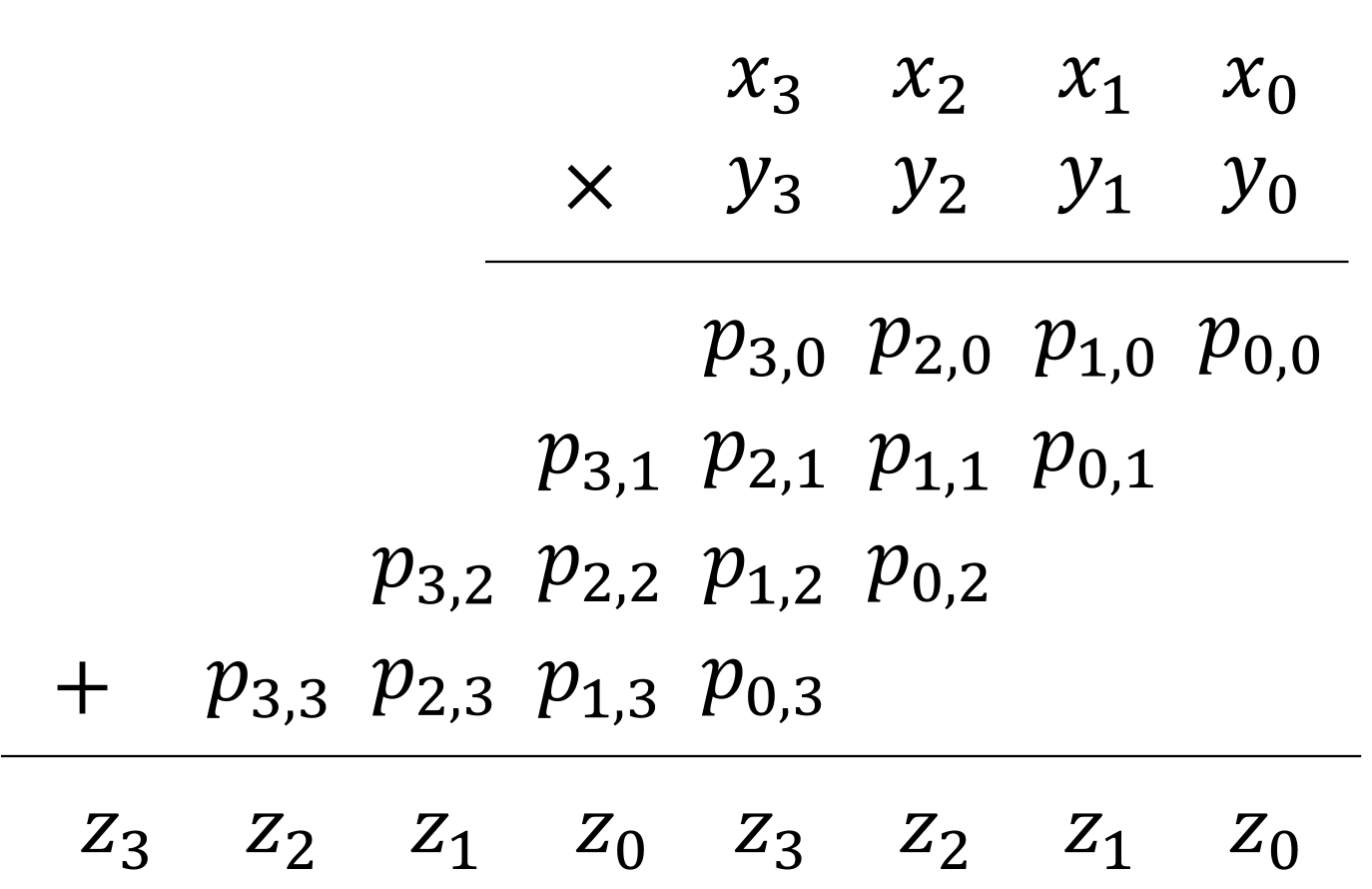
Multiplication of two integers can be performed using additions. In this section, we design a multiplier for two 4-bit integers using full adders. The figure below shows how two $x_3x_2x_1x_0$ and $y_3y_2y_1y_0$ are multiplied to obtain an 8-bit integer $z_7z_6z_5z_4z_3z_2z_1z_0$. In this figure, $p_{i,j}=x_iy_j$ ($0\leq i,j\leq 3$) and these partial products are summed to compute the final 8-bit result.
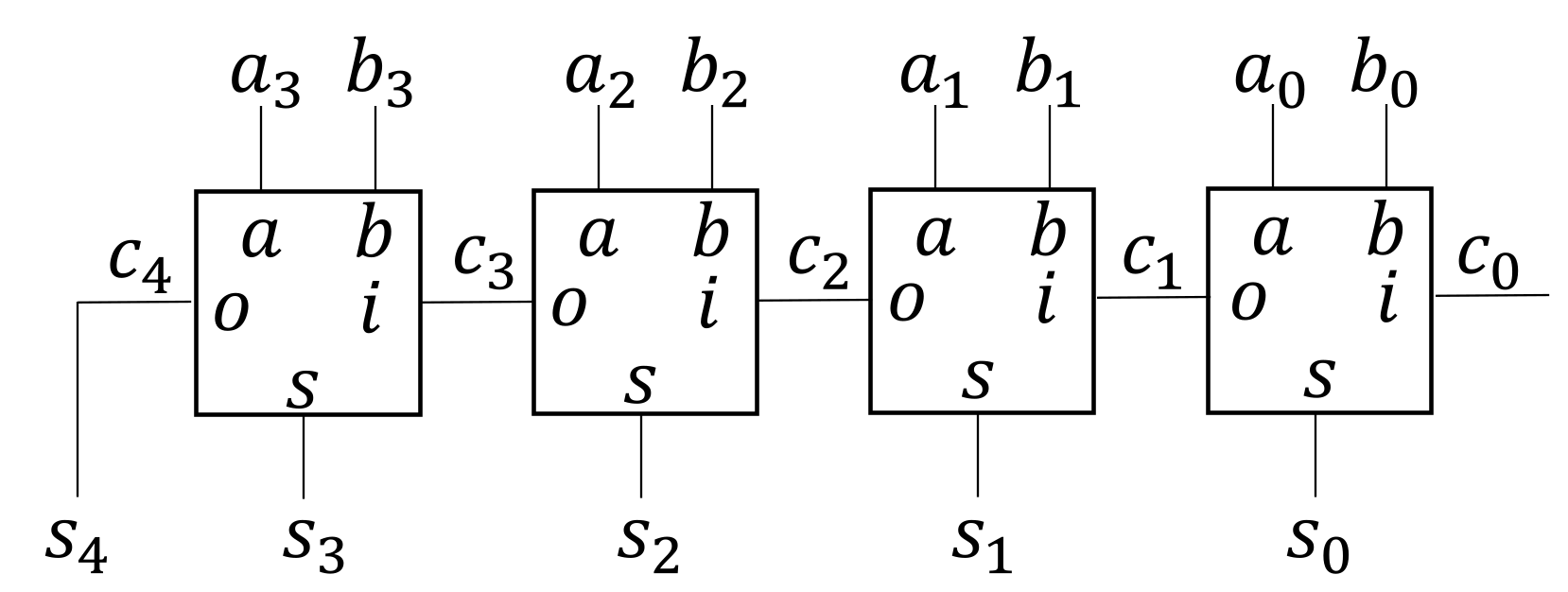
We use a 4-bit ripple-carry adder that computes the sum of two 4-bit integers $a_3a_2a_1a_0$ and $b_3b_2b_1b_0$ producing the 5-bit sum $z_4z_3z_2z_1z_0$. It consists of four full adders connected by a 5-bit carry wire $c_4c_3c_2c_1c_0$ that propagates carries.
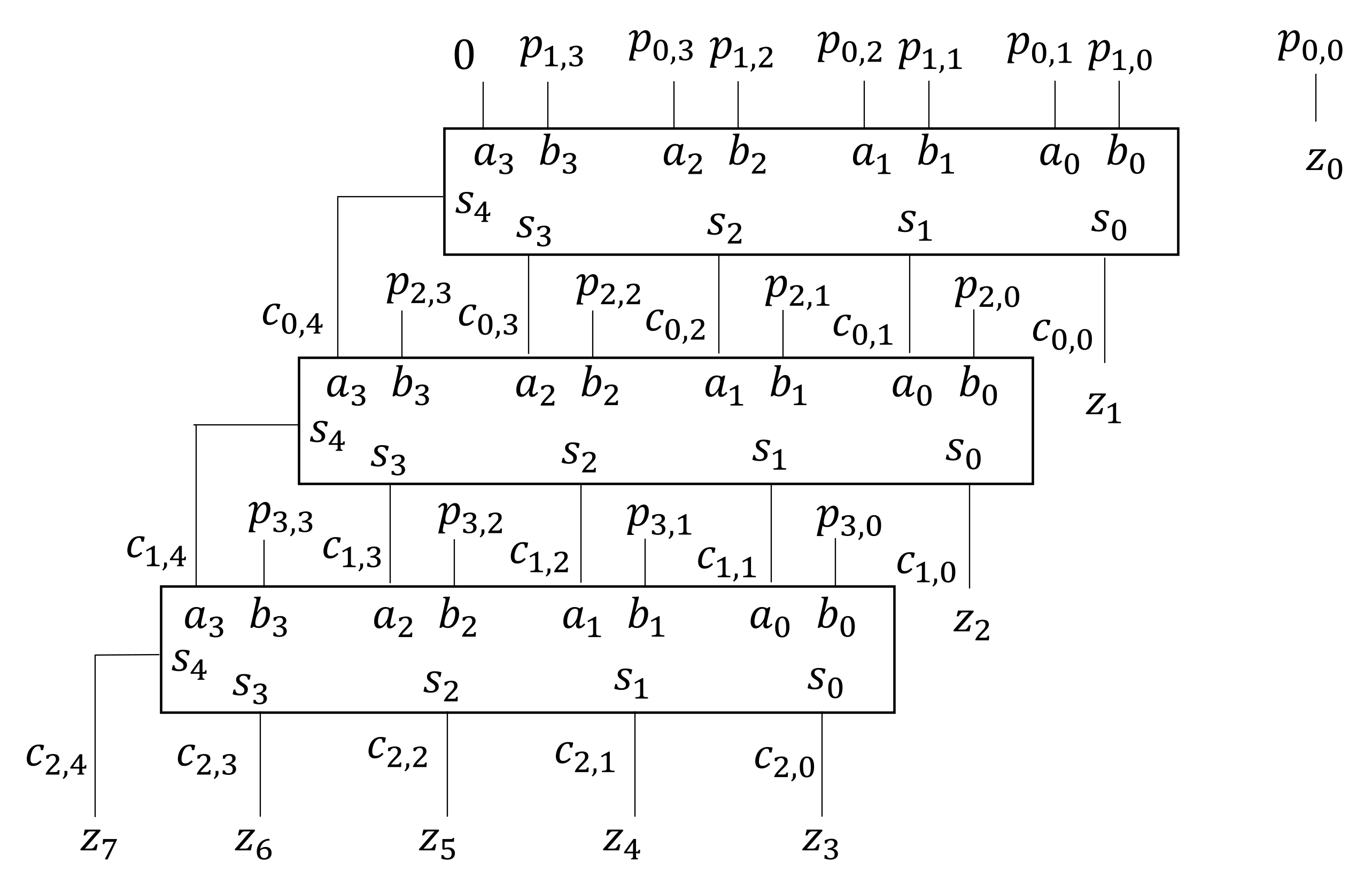
A 4-bit multiplier can be constructed using three 4-bit adders. They are connected by wires $c_{i,j}$ ($0\leq i\leq 2, 0\leq j\leq 3$) to propagate intermediate sum bits, as shown below:
QUBO formulation for multiplier
We will show QUBO formulation for simulating the N-bit multiplier. To do this, we implement functions that construct a full adder, an adder, and a multiplier.
Full adder
The following QUBO expression simulates a full adder with three input bits a, b, and i, and two output bits: carry-out o and sum s:
def fa(a, b, i, o, s):
    return (a + b + i) - (2 * o + s) == 0
The function fa returns an expression that enforces consistency between the input and output bits of a full adder.
Adder
Assume that lists a, b, and s represent integers. We assume that a and b each have N elements representing N-bit integers, while s has N + 1 elements representing an (N + 1)-bit integer. The following function adder returns a QUBO expression whose minimum value is 0 if and only if a + b == s holds:
def adder(a, b, s):
    N = len(a)
    c = qbpp.var(N + 1)
    f = 0
    for j in range(N):
        f += fa(a[j], b[j], c[j], c[j + 1], s[j])
    ml = [(c[0], 0), (c[N], s[N])]
    return qbpp.replace(f, ml)
In this function, c is a vector of N + 1 variables used to connect the carry-out and carry-in signals of the fa blocks, forming an N-bit ripple-carry adder.
Multiplier
Assume that lists x, y, and z represent integers. We assume that x and y each have N elements and that z has 2 * N elements. The following function multiplier returns a QUBO expression whose minimum value is 0 if and only if x * y == z holds.
def multiplier(x, y, z):
    N = len(x)
    c = qbpp.var("c", N - 1, N + 1)

    f = 0

    for i in range(N - 1):
        b_vec = [x[i + 1] * y[j] for j in range(N)]

        if i == 0:
            a_vec = [x[0] * y[j + 1] for j in range(N - 1)] + [0]
        else:
            a_vec = [c[i - 1][j + 1] for j in range(N)]

        s_vec = [c[i][j] for j in range(N + 1)]
        f += adder(a_vec, b_vec, s_vec)

    f += z[0] - x[0] * y[0] == 0

    ml = [(c[i][0], z[i + 1]) for i in range(N - 2)]
    ml += [(c[N - 2][i], z[N + i - 1]) for i in range(N + 1)]
    f = qbpp.replace(f, ml)
    f.simplify_as_binary()
    return f
This function uses an (N−1)×(N+1) matrix c of variables to connect the N−1 adders of N bits. Since each bit of z corresponds to one element of c, their correspondence is defined in ml, and the replacements are performed using replace().
PyQBPP program for factorization
Using the function multiplier, we can factor a composite integer into two factors. The following program constructs a 4-bit multiplier where x and y are 4 binary variables each, and z is a list of constants [1, 1, 1, 1, 0, 0, 0, 1] representing the 8-bit integer 10001111 (143):
import pyqbpp as qbpp

def fa(a, b, i, o, s):
    return (a + b + i) - (2 * o + s) == 0

def adder(a, b, s):
    N = len(a)
    c = qbpp.var(N + 1)
    f = 0
    for j in range(N):
        f += fa(a[j], b[j], c[j], c[j + 1], s[j])
    ml = [(c[0], 0), (c[N], s[N])]
    return qbpp.replace(f, ml)

def multiplier(x, y, z):
    N = len(x)
    c = qbpp.var("c", N - 1, N + 1)

    f = 0

    for i in range(N - 1):
        b_vec = [x[i + 1] * y[j] for j in range(N)]

        if i == 0:
            a_vec = [x[0] * y[j + 1] for j in range(N - 1)] + [0]
        else:
            a_vec = [c[i - 1][j + 1] for j in range(N)]

        s_vec = [c[i][j] for j in range(N + 1)]
        f += adder(a_vec, b_vec, s_vec)

    f += z[0] - x[0] * y[0] == 0

    ml = [(c[i][0], z[i + 1]) for i in range(N - 2)]
    ml += [(c[N - 2][i], z[N + i - 1]) for i in range(N + 1)]
    f = qbpp.replace(f, ml)
    f.simplify_as_binary()
    return f

x = qbpp.var("x", 4)
y = qbpp.var("y", 4)
z = [1, 1, 1, 1, 0, 0, 0, 1]
f = multiplier(x, y, z)
f.simplify_as_binary()

solver = qbpp.EasySolver(f)
sol = solver.search({"target_energy": 0})

x_bits = "".join(str(sol(x[j])) for j in reversed(range(4)))
y_bits = "".join(str(sol(y[j])) for j in reversed(range(4)))
z_bits = "".join(str(z[j]) for j in reversed(range(8)))
print(f"{x_bits} * {y_bits} = {z_bits}")
The Easy Solver is executed on f, and the obtained solution is stored in sol. The resulting values of x and y are printed as:
1011 * 1101 = 10001111
This output indicates $11\times 13 = 143$, demonstrating the factorization result.
乗算器シミュレーションと素因数分解
2つの整数の乗算は加算を用いて実行できます。 この節では、全加算器を使って2つの4ビット整数の乗算器を設計します。 以下の図は、2つの4ビット整数 $x_3x_2x_1x_0$ と $y_3y_2y_1y_0$ を乗算して8ビット整数 $z_7z_6z_5z_4z_3z_2z_1z_0$ を得る方法を示しています。 この図では、$p_{i,j}=x_iy_j$ ($0\leq i,j\leq 3$) であり、これらの部分積を合計して最終的な8ビットの結果を計算します。
2つの4ビット整数 $a_3a_2a_1a_0$ と $b_3b_2b_1b_0$ の和を計算して5ビットの和 $z_4z_3z_2z_1z_0$ を出力する4ビットリプルキャリー加算器を使用します。 これは、キャリーを伝搬する5ビットのキャリー線 $c_4c_3c_2c_1c_0$ で接続された4つの全加算器で構成されています。
4ビット乗算器は3つの4ビット加算器を使って構築できます。 以下に示すように、中間の和ビットを伝搬するためにワイヤ $c_{i,j}$ ($0\leq i\leq 2, 0\leq j\leq 3$) で接続されています:
乗算器の QUBO 定式化
Nビット乗算器をシミュレートするための QUBO 定式化を示します。 そのために、全加算器、加算器、乗算器を構築する関数を実装します。
全加算器
以下の QUBO 式は、3つの入力ビット a、b、i と、2つの出力ビット: キャリーアウト o および和 s を持つ全加算器をシミュレートします:
def fa(a, b, i, o, s):
    return (a + b + i) - (2 * o + s) == 0
関数 fa は、全加算器の入力ビットと出力ビットの間の整合性を強制する式を返します。
加算器
リスト a、b、s が整数を表すとします。 a と b はそれぞれ N 要素を持ち Nビット整数を表し、s は N + 1 要素を持ち (N + 1)ビット整数を表します。 以下の関数 adder は、a + b == s が成り立つ場合に限り最小値が 0 となる QUBO 式を返します:
def adder(a, b, s):
    N = len(a)
    c = qbpp.var(N + 1)
    f = 0
    for j in range(N):
        f += fa(a[j], b[j], c[j], c[j + 1], s[j])
    ml = [(c[0], 0), (c[N], s[N])]
    return qbpp.replace(f, ml)
この関数では、c は N + 1 個の変数のベクトルで、fa ブロックのキャリーアウトとキャリーインの信号を接続し、Nビットのリプルキャリー加算器を形成します。
乗算器
リスト x、y、z が整数を表すとします。 x と y はそれぞれ N 要素を持ち、z は 2 * N 要素を持つとします。 以下の関数 multiplier は、x * y == z が成り立つ場合に限り最小値が 0 となる QUBO 式を返します。
def multiplier(x, y, z):
    N = len(x)
    c = qbpp.var("c", N - 1, N + 1)

    f = 0

    for i in range(N - 1):
        b_vec = [x[i + 1] * y[j] for j in range(N)]

        if i == 0:
            a_vec = [x[0] * y[j + 1] for j in range(N - 1)] + [0]
        else:
            a_vec = [c[i - 1][j + 1] for j in range(N)]

        s_vec = [c[i][j] for j in range(N + 1)]
        f += adder(a_vec, b_vec, s_vec)

    f += z[0] - x[0] * y[0] == 0

    ml = [(c[i][0], z[i + 1]) for i in range(N - 2)]
    ml += [(c[N - 2][i], z[N + i - 1]) for i in range(N + 1)]
    f = qbpp.replace(f, ml)
    f.simplify_as_binary()
    return f
この関数は (N-1)x(N+1) の変数行列 c を使って N-1 個の Nビット加算器を接続します。 z の各ビットは c の1つの要素に対応するため、その対応関係を ml で定義し、replace() を使って置換を実行します。
素因数分解の PyQBPP プログラム
関数 multiplier を使って、合成数を2つの因数に分解できます。 以下のプログラムは、x と y をそれぞれ4つのバイナリ変数、 z を定数リスト [1, 1, 1, 1, 0, 0, 0, 1](8ビット整数 10001111 (143) を表す)として4ビット乗算器を構築します:
import pyqbpp as qbpp

def fa(a, b, i, o, s):
    return (a + b + i) - (2 * o + s) == 0

def adder(a, b, s):
    N = len(a)
    c = qbpp.var(N + 1)
    f = 0
    for j in range(N):
        f += fa(a[j], b[j], c[j], c[j + 1], s[j])
    ml = [(c[0], 0), (c[N], s[N])]
    return qbpp.replace(f, ml)

def multiplier(x, y, z):
    N = len(x)
    c = qbpp.var("c", N - 1, N + 1)

    f = 0

    for i in range(N - 1):
        b_vec = [x[i + 1] * y[j] for j in range(N)]

        if i == 0:
            a_vec = [x[0] * y[j + 1] for j in range(N - 1)] + [0]
        else:
            a_vec = [c[i - 1][j + 1] for j in range(N)]

        s_vec = [c[i][j] for j in range(N + 1)]
        f += adder(a_vec, b_vec, s_vec)

    f += z[0] - x[0] * y[0] == 0

    ml = [(c[i][0], z[i + 1]) for i in range(N - 2)]
    ml += [(c[N - 2][i], z[N + i - 1]) for i in range(N + 1)]
    f = qbpp.replace(f, ml)
    f.simplify_as_binary()
    return f

x = qbpp.var("x", 4)
y = qbpp.var("y", 4)
z = [1, 1, 1, 1, 0, 0, 0, 1]
f = multiplier(x, y, z)
f.simplify_as_binary()

solver = qbpp.EasySolver(f)
sol = solver.search({"target_energy": 0})

x_bits = "".join(str(sol(x[j])) for j in reversed(range(4)))
y_bits = "".join(str(sol(y[j])) for j in reversed(range(4)))
z_bits = "".join(str(z[j]) for j in reversed(range(8)))
print(f"{x_bits} * {y_bits} = {z_bits}")
Easy Solver が f に対して実行され、得られた解が sol に格納されます。 x と y の結果の値は以下のように出力されます:
1011 * 1101 = 10001111
この出力は $11\times 13 = 143$ を示しており、素因数分解の結果を実証しています。