Traveling Salesman Problem
The Traveling Salesman Problem (TSP) asks for the shortest tour that visits every node exactly once and returns to the start. We assume that the nodes are placed on a plane and that the tour length is measured using the Euclidean distance.
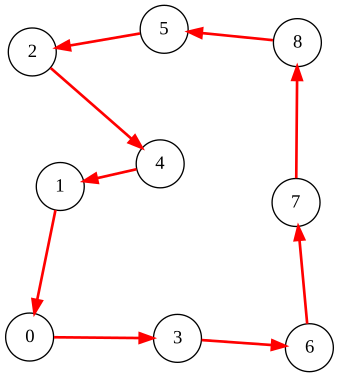
In the figure below, an example of nine nodes and an optimal tour is shown:
QUBO formulation of the TSP
A tour can be represented by a permutation of the nodes. Accordingly, we use a permutation matrix to encode a TSP solution.
Let $X=(x_{i,j})$ ($0\leq i,j\leq n-1$) be a matrix of $n\times n$ binary values. The matrix $X$ is a permutation matrix each row and each column contains exactly one entry equal to 1, as illustrated below.
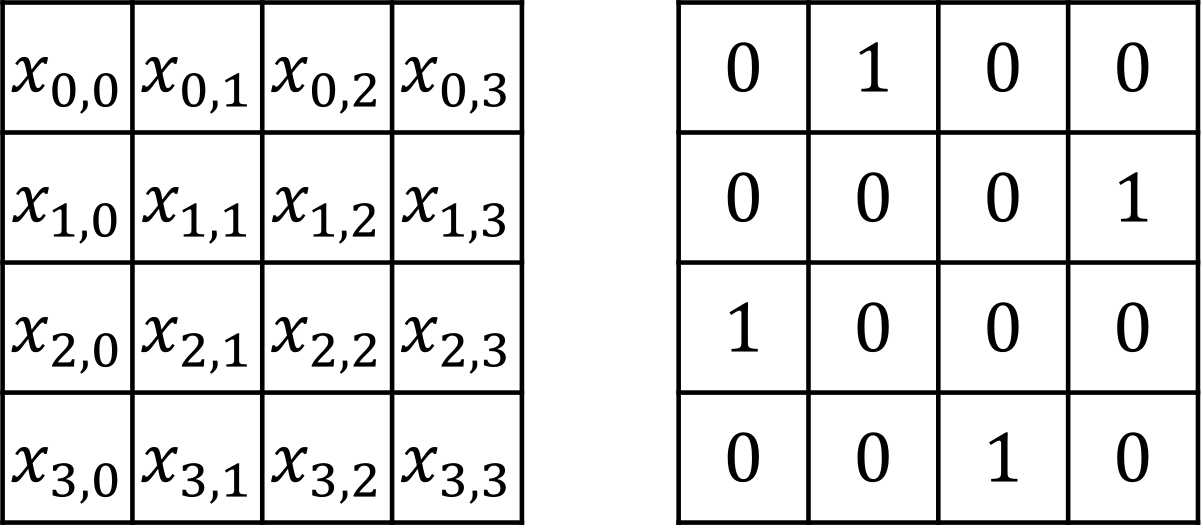
We interpret $x_{k,i}$ as “the $k$-th position in the tour is node $i$”. Therefore, every row and every column of $X$ must be one-hot, i.e., the following constraints must hold:
\[\begin{aligned} {\rm row}:& \sum_{j=0}^{n-1}x_{i,j}=1 & (0\leq i\leq n-1)\\ {\rm column}:& \sum_{i=0}^{n-1}x_{i,j}=1 & (0\leq j\leq n-1) \end{aligned}\]Let $d_{i,j}$ denote the distance between nodes $i$ and $j$. Then the tour length for a permutation matrix $X$ can be written as:
\[\begin{aligned} {\rm objective}: &\sum_{k=0}^{k-1} d_{i,j}x_{k,i}x_{(k+1)\bmod n,j} \end{aligned}\]This expression adds $d_{i,j}$ exactly when node $i$ is visited at position $k$ and node $j$ is visited next (at position $(k+1)\bmod n$), so it equals the total length of the tour.
QUBO++ program for TSP
Using the permutation-matrix formulation above, we can write a QUBO++ program for the TSP as follows:
#include <cmath>
#include <qbpp/qbpp.hpp>
#include <qbpp/easy_solver.hpp>
#include <qbpp/graph.hpp>

class Nodes {
  std::vector<std::pair<int, int>> nodes{{10, 12},  {33, 125},  {12, 226},
                                         {121, 11}, {108, 142}, {111, 243},
                                         {220, 4},  {210, 113}, {211, 233}};

 public:
  const std::pair<int, int>& operator[](std::size_t index) const {
    return nodes[index];
  }

  std::size_t size() const { return nodes.size(); }

  int dist(std::size_t i, std::size_t j) const {
    auto [x1, y1] = nodes[i];
    auto [x2, y2] = nodes[j];
    const int dx = x1 - x2;
    const int dy = y1 - y2;
    return static_cast<int>(
        std::llround(std::sqrt(static_cast<double>(dx * dx + dy * dy))));
  }
};

int main() {
  auto nodes = Nodes{};
  auto x = qbpp::var("x", nodes.size(), nodes.size());

  auto constraint = qbpp::sum(qbpp::vector_sum(x, 1) == 1) +
                    qbpp::sum(qbpp::vector_sum(x, 0) == 1);

  auto objective = qbpp::expr();
  for (size_t i = 0; i < nodes.size(); ++i) {
    auto next_i = (i + 1) % nodes.size();
    for (size_t j = 0; j < nodes.size(); ++j) {
      for (size_t k = 0; k < nodes.size(); ++k) {
        if (k != j) {
          objective += nodes.dist(j, k) * x[i][j] * x[next_i][k];
        }
      }
    }
  }

  auto f = objective + constraint * 1000;
  f.simplify_as_binary();

  auto solver = qbpp::easy_solver::EasySolver(f);
  auto sol = solver.search({{"time_limit", 1.0}});
  auto tour = qbpp::onehot_to_int(sol(x));

  std::cout << "Tour: " << tour << "\n";
  auto graph = qbpp::graph::GraphDrawer();
  for (size_t i = 0; i < nodes.size(); ++i) {
    graph.add(qbpp::graph::Node(i).position(nodes[i].first, nodes[i].second));
  }
  for (size_t i = 0; i < nodes.size(); ++i) {
    auto from = tour[i];
    auto to = tour[(i + 1) % nodes.size()];
    graph.add(qbpp::graph::Edge(from, to).color("red").penwidth(2).directed());
  }
  graph.write("tsp_solution.svg");
}
In this program, the coordinates of nodes 0 through 8 are stored in a Nodes object named nodes. We create a 2D array x of binary variables and construct the one-hot constraints together with the tour-length objective. These terms are combined into a single QUBO expression f by adding the constraints with a penalty weight (here, 1000) to prioritize feasibility.
We then solve f using EasySolver with a 1.0-second time limit. The resulting assignment sol(x) forms a permutation matrix. This matrix is converted into a list of integers (a permutation) called tour using qbpp::onehot_to_int(), and then printed. Finally, the computed tour is rendered as a directed graph and saved to the file tsp_solution.svg.
This program produces the following output:
Tour: {7,8,5,2,4,1,0,3,6}
Fixing the first node
Without loss of generality, we can assume that node 0 is the starting node of the tour. Because the TSP tour is invariant under cyclic shifts, fixing the start position does not change the optimal tour length.
By fixing the start node, we can reduce the number of binary variables in the QUBO expression. Specifically, we enforce that node 0 is assigned to position 0 in the permutation matrix. To do this, we fix the following binary variables:
\[\begin{aligned} x_{0,0} &= 1\\ x_{i,0} &= 0& (i\geq 1)\\ x_{0,j} &= 0& (j\geq 1) \end{aligned}\]These assignments ensure that node 0 appears only at position 0, and that no other node is assigned to position 0. As a result, the effective problem size is reduced, which generally makes the QUBO easier to solve for local-search–based solvers.
QUBO++ program for fixing the first node
In QUBO++, fixed variable assignments can be applied using the qbpp::replace() function:
  qbpp::MapList ml;
  ml.push_back({x[0][0], 1});
  for (size_t i = 1; i < nodes.size(); ++i) {
    ml.push_back({x[i][0], 0});
    ml.push_back({x[0][i], 0});
  }

  auto g = qbpp::replace(f, ml);
  g.simplify_as_binary();

  auto solver = qbpp::easy_solver::EasySolver(g);
  auto sol = solver.search({{"time_limit", 1.0}});

  auto full_sol = qbpp::Sol(f).set(sol).set(ml);
  auto tour = qbpp::onehot_to_int(full_sol(x));
  std::cout << "Tour: " << tour << "\n";
First, we create a qbpp::MapList object ml, which stores fixed assignments of variables. Each assignment is added using the push_back() member function.
Next, we call qbpp::replace(f, ml), which returns a new expression obtained by substituting the fixed values specified in ml into the original QUBO expression f. The resulting expression is stored in g and simplified.
We then create a solver for g and obtain a solution sol. Since sol corresponds to the reduced problem, we create a qbpp::Sol object for f and set both the solver output sol and the fixed assignments ml. The resulting full_sol stores the complete assignment for all variables in x.
Finally, the permutation matrix represented by full_sol(x) is converted into a permutation using qbpp::onehot_to_int() and printed.
This program produces the following tour starting from node 0:
Tour: {0,3,6,7,8,5,2,1,4}
巡回セールスマン問題
巡回セールスマン問題(TSP)は、すべての頂点をちょうど1回ずつ訪問して出発点に戻る最短巡回路を求める問題です。 頂点は平面上に配置され、巡回路の長さはユークリッド距離で測られるものとします。
以下の図は、9頂点と最適巡回路の例を示しています:
TSPのQUBO定式化
巡回路は頂点の順列として表現できます。 そこで、TSPの解を符号化するために置換行列を使用します。
$X=(x_{i,j})$($0\leq i,j\leq n-1$)を $n\times n$ のバイナリ値の行列とします。 行列 $X$ は置換行列であり、各行と各列にちょうど1つの1が含まれます。以下に例を示します。
$x_{k,i}$ を「巡回路の $k$ 番目の位置が頂点 $i$ である」と解釈します。 したがって、$X$ のすべての行とすべての列はone-hotでなければなりません。すなわち以下の制約が成り立つ必要があります:
\[\begin{aligned} {\rm row}:& \sum_{j=0}^{n-1}x_{i,j}=1 & (0\leq i\leq n-1)\\ {\rm column}:& \sum_{i=0}^{n-1}x_{i,j}=1 & (0\leq j\leq n-1) \end{aligned}\]$d_{i,j}$ を頂点 $i$ と $j$ の間の距離とします。 置換行列 $X$ に対する巡回路の長さは次のように書けます:
\[\begin{aligned} {\rm objective}: &\sum_{k=0}^{k-1} d_{i,j}x_{k,i}x_{(k+1)\bmod n,j} \end{aligned}\]この式は、頂点 $i$ が位置 $k$ で訪問され、頂点 $j$ が次の位置($(k+1)\bmod n$)で訪問されるときにちょうど $d_{i,j}$ を加算するので、巡回路の総距離に等しくなります。
TSPのQUBO++プログラム
上記の置換行列による定式化を用いて、TSPのQUBO++プログラムを以下のように記述できます:
#include <cmath>
#include <qbpp/qbpp.hpp>
#include <qbpp/easy_solver.hpp>
#include <qbpp/graph.hpp>

class Nodes {
  std::vector<std::pair<int, int>> nodes{{10, 12},  {33, 125},  {12, 226},
                                         {121, 11}, {108, 142}, {111, 243},
                                         {220, 4},  {210, 113}, {211, 233}};

 public:
  const std::pair<int, int>& operator[](std::size_t index) const {
    return nodes[index];
  }

  std::size_t size() const { return nodes.size(); }

  int dist(std::size_t i, std::size_t j) const {
    auto [x1, y1] = nodes[i];
    auto [x2, y2] = nodes[j];
    const int dx = x1 - x2;
    const int dy = y1 - y2;
    return static_cast<int>(
        std::llround(std::sqrt(static_cast<double>(dx * dx + dy * dy))));
  }
};

int main() {
  auto nodes = Nodes{};
  auto x = qbpp::var("x", nodes.size(), nodes.size());

  auto constraint = qbpp::sum(qbpp::vector_sum(x, 1) == 1) +
                    qbpp::sum(qbpp::vector_sum(x, 0) == 1);

  auto objective = qbpp::expr();
  for (size_t i = 0; i < nodes.size(); ++i) {
    auto next_i = (i + 1) % nodes.size();
    for (size_t j = 0; j < nodes.size(); ++j) {
      for (size_t k = 0; k < nodes.size(); ++k) {
        if (k != j) {
          objective += nodes.dist(j, k) * x[i][j] * x[next_i][k];
        }
      }
    }
  }

  auto f = objective + constraint * 1000;
  f.simplify_as_binary();

  auto solver = qbpp::easy_solver::EasySolver(f);
  auto sol = solver.search({{"time_limit", 1.0}});
  auto tour = qbpp::onehot_to_int(sol(x));

  std::cout << "Tour: " << tour << "\n";
  auto graph = qbpp::graph::GraphDrawer();
  for (size_t i = 0; i < nodes.size(); ++i) {
    graph.add(qbpp::graph::Node(i).position(nodes[i].first, nodes[i].second));
  }
  for (size_t i = 0; i < nodes.size(); ++i) {
    auto from = tour[i];
    auto to = tour[(i + 1) % nodes.size()];
    graph.add(qbpp::graph::Edge(from, to).color("red").penwidth(2).directed());
  }
  graph.write("tsp_solution.svg");
}
このプログラムでは、頂点 0 から 8 の座標が Nodes オブジェクト nodes に格納されています。 バイナリ変数の2次元配列 x を作成し、one-hot制約と巡回路長の目的関数を構成します。 これらの項は、制約にペナルティ重み(ここでは 1000)を付けて加算することで、1つのQUBO式 f にまとめられます。実行可能性が優先されます。
次に、1.0秒の制限時間で EasySolver を使って f を解きます。 得られた割り当て sol(x) は置換行列を形成します。 この行列は qbpp::onehot_to_int() を使って整数のリスト(順列)tour に変換され、出力されます。 最後に、計算された tour が有向グラフとして描画され、ファイル tsp_solution.svg に保存されます。
このプログラムは以下の出力を生成します:
Tour: {7,8,5,2,4,1,0,3,6}
最初の頂点の固定
一般性を失うことなく、頂点0を巡回路の出発点と仮定できます。 TSPの巡回路は巡回シフトに対して不変であるため、出発位置を固定しても最適巡回路長は変わりません。
出発頂点を固定することで、QUBO式中のバイナリ変数の数を削減できます。 具体的には、置換行列において頂点0を位置0に割り当てることを強制します。 そのために、以下のバイナリ変数を固定します:
\[\begin{aligned} x_{0,0} &= 1\\ x_{i,0} &= 0& (i\geq 1)\\ x_{0,j} &= 0& (j\geq 1) \end{aligned}\]これらの割り当てにより、頂点0は位置0にのみ現れ、他の頂点は位置0に割り当てられません。 結果として、実効的な問題サイズが削減され、局所探索ベースのソルバーにとってQUBOが解きやすくなります。
最初の頂点を固定するQUBO++プログラム
QUBO++では、固定された変数の割り当てを qbpp::replace() 関数を使って適用できます:
  qbpp::MapList ml;
  ml.push_back({x[0][0], 1});
  for (size_t i = 1; i < nodes.size(); ++i) {
    ml.push_back({x[i][0], 0});
    ml.push_back({x[0][i], 0});
  }

  auto g = qbpp::replace(f, ml);
  g.simplify_as_binary();

  auto solver = qbpp::easy_solver::EasySolver(g);
  auto sol = solver.search({{"time_limit", 1.0}});

  auto full_sol = qbpp::Sol(f).set(sol).set(ml);
  auto tour = qbpp::onehot_to_int(full_sol(x));
  std::cout << "Tour: " << tour << "\n";
まず、変数の固定割り当てを格納する qbpp::MapList オブジェクト ml を作成します。 各割り当ては push_back() メンバ関数で追加されます。
次に、qbpp::replace(f, ml) を呼び出します。これは ml で指定された固定値を元のQUBO式 f に代入して得られる新しい式を返します。 結果の式は g に格納され、簡約化されます。
次に、g に対するソルバーを作成して解 sol を得ます。 sol は縮小された問題に対応するため、f に対する qbpp::Sol オブジェクトを作成し、ソルバーの出力 sol と固定割り当て ml の両方を設定します。 結果の full_sol は x のすべての変数に対する完全な割り当てを格納します。
最後に、full_sol(x) で表される置換行列が qbpp::onehot_to_int() を使って順列に変換され、出力されます。
このプログラムは頂点0から始まる以下の巡回路を生成します:
Tour: {0,3,6,7,8,5,2,1,4}