Subgraph Isomorphism Problem
Given two undirected graphs $G_H=(V_H,E_H)$ (the host graph) and $G_G=(V_G,E_G)$ (the guest graph), the subgraph isomorphism problem asks whether $G_H$ contains a subgraph that is isomorphic to $G_G$.
More formally, the goal is to find an injective mapping $\sigma:V_G\rightarrow V_H$ such that, for every edge $(u,v)\in E_G$, the pair $(\sigma(u),\sigma(v))$ is also an edge of the host graph, i.e., $(\sigma(u),\sigma(v))\in E_H$.
For example, consider the following host and guest graphs:
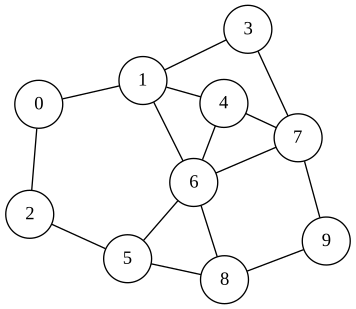
An example of the host graph $G_H=(V_H,E_H)$ with 10 nodes
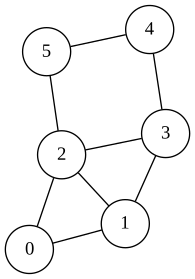
An example of the guest graph $G_G=(V_G,E_G)$ with 6 nodes
QUBO formulation of the subgraph isomorphism problem
Assume that the guest graph $G_G=(V_G,E_G)$ has $m$ nodes labeled $0, 1, \ldots m-1$, and the host graph $G_H=(V_H,E_H)$ has $n$ nodes labeled $0, 1, \ldots n-1$. We introduce an $m\times n$ binary matrix $X=(x_{i,j})$ ($0\leq i\leq m-1, 0\leq j\leq n-1$) with $mn$ binary variables. This matrix represents an injective mapping $\sigma:V_G\rightarrow V_H$ such that $x_{i,j}=1$ if and only if $\sigma(i)=j$.
Because $X$ represents an injective mapping, it must satisfy the following constraints:
- Row constraint: Each guest node is mapped to exactly one host node, i.e., the sum of each row is 1.
- Column constraint: Each host node is used by at most one guest node, i.e., the sum of each column is 0 or 1.
Next, we define the objective as the number of guest edges that are mapped to host edges:
\[\begin{aligned} \text{objective} &= \sum_{(u_G,v_G)\in E_G}\sum_{(u_H,v_H)\in E_H} (x_{u_G,u_H}x_{v_G,v_H}+x_{u_G,v_H}x_{v_G,u_H}) \end{aligned}\]Finally, we combine the objective and the constraint into a single QUBO expression:
\[\begin{aligned} f &= -\text{objective} + mn\times \text{constraint} \end{aligned}\]PyQBPP program for the subgraph isomorphism problem
import pyqbpp as qbpp

N = 10
host = [
    (0, 1), (0, 2), (1, 3), (1, 4), (1, 6), (2, 5), (3, 7), (4, 6),
    (4, 7), (5, 6), (5, 8), (6, 8), (6, 7), (7, 9), (8, 9)]

M = 6
guest = [
    (0, 1), (0, 2), (1, 2), (1, 3), (2, 3), (2, 5), (3, 4), (4, 5)]

x = qbpp.var("x", M, N)

host_assigned = qbpp.vector_sum(x, 0)

constraint = qbpp.sum(qbpp.vector_sum(x, 1) == 1) + qbpp.sum(qbpp.between(host_assigned, 0, 1))

objective = 0
for ug, vg in guest:
    for uh, vh in host:
        objective += x[ug][uh] * x[vg][vh] + x[ug][vh] * x[vg][uh]

f = -objective + constraint * (M * N)
f.simplify_as_binary()

solver = qbpp.EasySolver(f)
sol = solver.search({"target_energy": -len(guest)})

print(f"objective = {sol(objective)}")
print(f"constraint = {sol(constraint)}")

# Extract guest-to-host mapping
print("Guest -> Host mapping:")
for i in range(M):
    for j in range(N):
        if sol(x[i][j]) == 1:
            print(f"  guest {i} -> host {j}")
The guest and host graphs are given as edge lists. We define an $M\times N$ binary matrix x, and then construct the expressions constraint, objective, and f according to the formulation above.
An Easy Solver instance is created for f, and a search is performed with the target energy $− | E_G | $ (the negative number of guest edges), which is the best possible value of -objective when all guest edges are mapped to host edges. |
This program produces the following output:
objective = 8
constraint = 0
Guest -> Host mapping:
  guest 0 -> host 1
  guest 1 -> host 4
  guest 2 -> host 6
  guest 3 -> host 7
  guest 4 -> host 9
  guest 5 -> host 8
| The objective value equals the number of guest edges ($ | E_G | =8$), and all constraints are satisfied. |
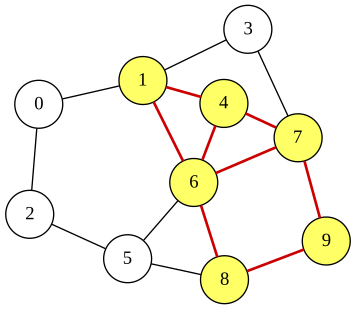
A solution to the subgraph isomorphism problem
Visualization using matplotlib
The following code visualizes the Subgraph Isomorphism solution on the host graph:
import matplotlib.pyplot as plt
import networkx as nx

G_host = nx.Graph()
G_host.add_nodes_from(range(N_host))
G_host.add_edges_from(host_edges)
pos = nx.spring_layout(G_host, seed=42)

# Determine which host nodes are mapped
mapped = [0] * N_host
for i in range(N_guest):
    for j in range(N_host):
        if sol(x[i][j]) == 1:
            mapped[j] = 1
colors = ["#e74c3c" if mapped[j] else "#d5dbdb" for j in range(N_host)]

# Highlight edges corresponding to guest edges
edge_colors = []
edge_widths = []
guest_to_host = {}
for i in range(N_guest):
    for j in range(N_host):
        if sol(x[i][j]) == 1:
            guest_to_host[i] = j
for u, v in host_edges:
    host_to_guest_u = {v2: k for k, v2 in guest_to_host.items()}
    gu = host_to_guest_u.get(u)
    gv = host_to_guest_u.get(v)
    if gu is not None and gv is not None and (gu, gv) in guest_edges or (gv, gu) in guest_edges:
        edge_colors.append("#e74c3c")
        edge_widths.append(2.5)
    else:
        edge_colors.append("#cccccc")
        edge_widths.append(1.0)

nx.draw(G_host, pos, with_labels=True, node_color=colors, node_size=400,
        font_size=9, edge_color=edge_colors, width=edge_widths)
plt.title("Subgraph Isomorphism")
plt.savefig("subgraph_isomorphism.png", dpi=150, bbox_inches="tight")
plt.show()
Mapped host nodes are shown in red, and edges corresponding to guest edges are highlighted.
部分グラフ同型問題
2つの無向グラフ $G_H=(V_H,E_H)$(ホストグラフ)と $G_G=(V_G,E_G)$(ゲストグラフ)が与えられたとき、部分グラフ同型問題は $G_H$ が $G_G$ と同型な部分グラフを含むかどうかを問う問題です。
より形式的には、すべての辺 $(u,v)\in E_G$ に対して $(\sigma(u),\sigma(v))$ もホストグラフの辺である(すなわち $(\sigma(u),\sigma(v))\in E_H$)ような単射写像 $\sigma:V_G\rightarrow V_H$ を求めることが目標です。
例として、以下のホストグラフとゲストグラフを考えます:
10ノードのホストグラフ $G_H=(V_H,E_H)$ の例
6ノードのゲストグラフ $G_G=(V_G,E_G)$ の例
部分グラフ同型問題のQUBO定式化
ゲストグラフ $G_G=(V_G,E_G)$ が $0, 1, \ldots m-1$ とラベル付けされた $m$ 個のノードを持ち、ホストグラフ $G_H=(V_H,E_H)$ が $0, 1, \ldots n-1$ とラベル付けされた $n$ 個のノードを持つとします。 $mn$ 個のバイナリ変数を持つ $m\times n$ のバイナリ行列 $X=(x_{i,j})$($0\leq i\leq m-1, 0\leq j\leq n-1$)を導入します。 この行列は $x_{i,j}=1$ のとき $\sigma(i)=j$ となるような単射写像 $\sigma:V_G\rightarrow V_H$ を表します。
$X$ が単射写像を表すため、以下の制約を満たす必要があります:
- 行制約: 各ゲストノードはちょうど1つのホストノードに写像される、すなわち各行の和が1である。
- 列制約: 各ホストノードは最大1つのゲストノードに使用される、すなわち各列の和が0または1である。
次に、ホストグラフの辺に写像されたゲストグラフの辺の数を目的関数として定義します:
\[\begin{aligned} \text{objective} &= \sum_{(u_G,v_G)\in E_G}\sum_{(u_H,v_H)\in E_H} (x_{u_G,u_H}x_{v_G,v_H}+x_{u_G,v_H}x_{v_G,u_H}) \end{aligned}\]最終的に、目的関数と制約を1つのQUBO式にまとめます:
\[\begin{aligned} f &= -\text{objective} + mn\times \text{constraint} \end{aligned}\]部分グラフ同型問題のPyQBPPプログラム
import pyqbpp as qbpp

N = 10
host = [
    (0, 1), (0, 2), (1, 3), (1, 4), (1, 6), (2, 5), (3, 7), (4, 6),
    (4, 7), (5, 6), (5, 8), (6, 8), (6, 7), (7, 9), (8, 9)]

M = 6
guest = [
    (0, 1), (0, 2), (1, 2), (1, 3), (2, 3), (2, 5), (3, 4), (4, 5)]

x = qbpp.var("x", M, N)

host_assigned = qbpp.vector_sum(x, 0)

constraint = qbpp.sum(qbpp.vector_sum(x, 1) == 1) + qbpp.sum(qbpp.between(host_assigned, 0, 1))

objective = 0
for ug, vg in guest:
    for uh, vh in host:
        objective += x[ug][uh] * x[vg][vh] + x[ug][vh] * x[vg][uh]

f = -objective + constraint * (M * N)
f.simplify_as_binary()

solver = qbpp.EasySolver(f)
sol = solver.search({"target_energy": -len(guest)})

print(f"objective = {sol(objective)}")
print(f"constraint = {sol(constraint)}")

# Extract guest-to-host mapping
print("Guest -> Host mapping:")
for i in range(M):
    for j in range(N):
        if sol(x[i][j]) == 1:
            print(f"  guest {i} -> host {j}")
ゲストグラフとホストグラフは辺リストとして与えられます。 $M\times N$ のバイナリ行列 x を定義し、上記の定式化に従って constraint、objective、f の式を構築します。
Easy Solverのインスタンスを f に対して作成し、ターゲットエネルギー $− | E_G | $(ゲストグラフの辺数の負値)を search() のパラメータとして渡して探索を実行します。これは、すべてのゲストグラフの辺がホストグラフの辺に写像されたときの -objective の最良値です。 |
このプログラムの出力は以下のとおりです:
objective = 8
constraint = 0
Guest -> Host mapping:
  guest 0 -> host 1
  guest 1 -> host 4
  guest 2 -> host 6
  guest 3 -> host 7
  guest 4 -> host 9
  guest 5 -> host 8
| 目的関数値はゲストグラフの辺数($ | E_G | =8$)と等しく、すべての制約が満たされています。 |
部分グラフ同型問題の解
matplotlibによる可視化
以下のコードは、ホストグラフ上で部分グラフ同型の解を可視化します:
import matplotlib.pyplot as plt
import networkx as nx

G_host = nx.Graph()
G_host.add_nodes_from(range(N_host))
G_host.add_edges_from(host_edges)
pos = nx.spring_layout(G_host, seed=42)

# Determine which host nodes are mapped
mapped = [0] * N_host
for i in range(N_guest):
    for j in range(N_host):
        if sol(x[i][j]) == 1:
            mapped[j] = 1
colors = ["#e74c3c" if mapped[j] else "#d5dbdb" for j in range(N_host)]

# Highlight edges corresponding to guest edges
edge_colors = []
edge_widths = []
guest_to_host = {}
for i in range(N_guest):
    for j in range(N_host):
        if sol(x[i][j]) == 1:
            guest_to_host[i] = j
for u, v in host_edges:
    host_to_guest_u = {v2: k for k, v2 in guest_to_host.items()}
    gu = host_to_guest_u.get(u)
    gv = host_to_guest_u.get(v)
    if gu is not None and gv is not None and (gu, gv) in guest_edges or (gv, gu) in guest_edges:
        edge_colors.append("#e74c3c")
        edge_widths.append(2.5)
    else:
        edge_colors.append("#cccccc")
        edge_widths.append(1.0)

nx.draw(G_host, pos, with_labels=True, node_color=colors, node_size=400,
        font_size=9, edge_color=edge_colors, width=edge_widths)
plt.title("Subgraph Isomorphism")
plt.savefig("subgraph_isomorphism.png", dpi=150, bbox_inches="tight")
plt.show()
写像されたホストノードは赤色で表示され、ゲストグラフの辺に対応する辺が強調表示されます。